Colorado RV Storage: Denver Labor Day Prep & Security
Updated: Aug 29
Labor Day in Colorado is more than just the final long weekend for mountain getaways; it marks the start of a high-risk climate window for your vehicle. High-altitude UV rays and frequent hail cycles in the Denver area degrade RV seals and paint faster than almost anywhere else in the country. It is clear that the transition from summer fun to winter protection is a critical financial decision. You likely already feel the pressure of strict HOA restrictions on driveway parking the moment the holiday ends.
This article explores why ownership-based storage is the most effective way to protect your asset against Front Range climate variables. You will discover how a permanent, climate-controlled home base maintains RV resale value and provides a secure alternative to traditional rentals. We also provide concrete data on 2026 market pricing for garage condos to help you understand the current landscape of the Colorado Front Range market. This information ensures your investment remains protected through the harshest winter cycles.
Table of Contents
Colorado RVing After Labor Day: The Seasonal Shift to Storage
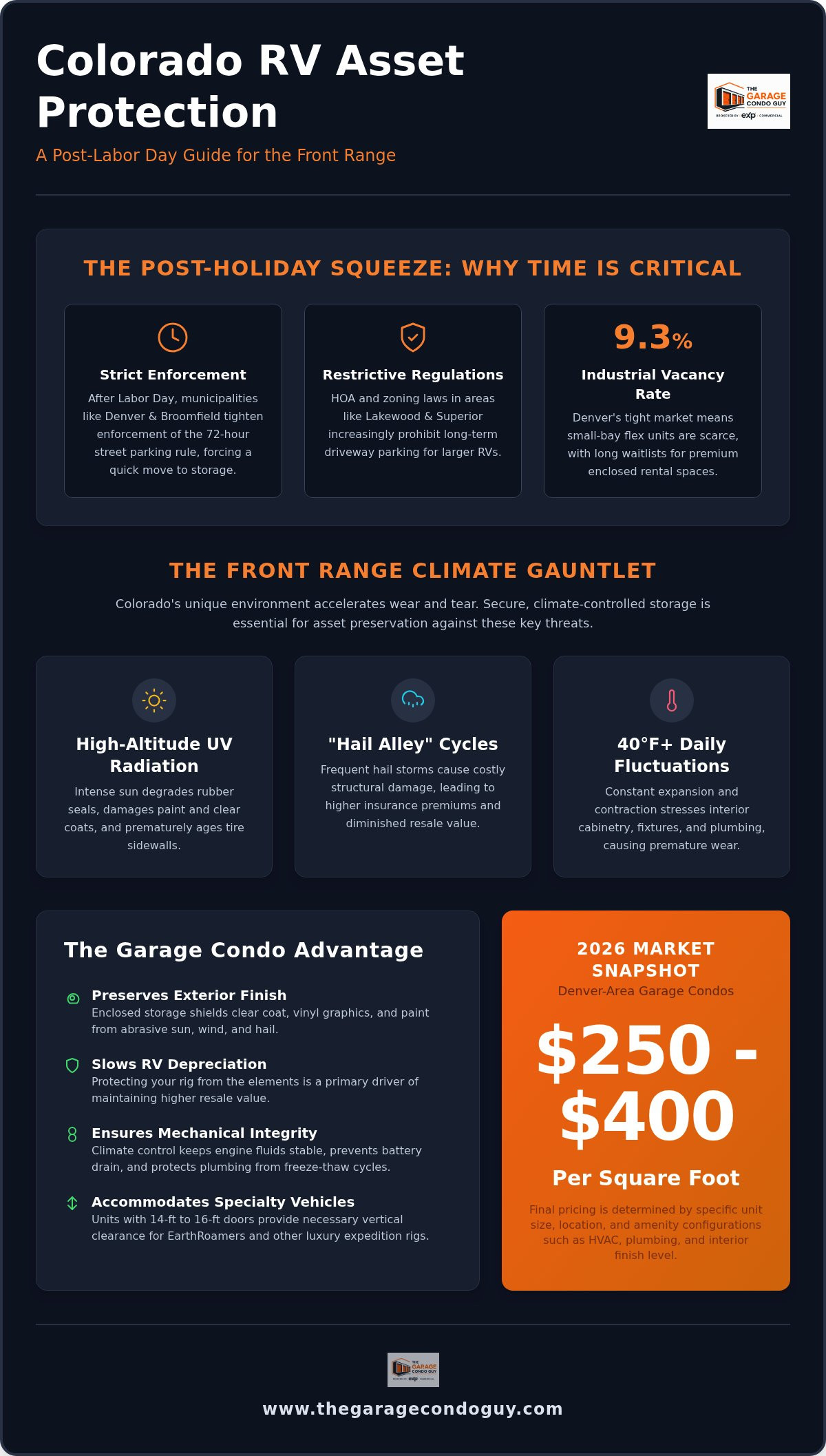
Labor Day acts as a definitive boundary for the Colorado camping season. Once the holiday passes, local authorities shift focus toward municipal parking enforcement. In cities like Denver and Broomfield, the 72-hour street parking rule is applied with increased vigor. This transition marks the moment when owners move from active adventure to asset preservation mode. HOA regulations in Front Range residential areas typically prohibit driveway parking after the summer months; leaving owners with few days to find a secure solution. As we write a Labor Day blog for The Garage Condo Guy targeting Colorado RV owners, the focus remains on the logistical reality of the Front Range. It is a necessary shift to protect high-value assets from the impending seasonal change.
Zoning and Local Ordinances in the Front Range
Local zoning laws are becoming more restrictive as we move into 2026. In Lakewood and Superior, updated ordinances specifically target the long-term placement of a recreational vehicle on residential property. Driveway storage is increasingly unviable for Class A motorhomes due to height and setback requirements. These rules ensure neighborhood aesthetics but often leave owners of luxury rigs without a legal place to park at home. Municipalities are prioritizing clear sightlines and emergency vehicle access, which often results in increased ticketing for oversized vehicles parked in residential zones.
The Scarcity of Small-Bay Storage in 2026
Finding a place to store a large rig is getting harder. The industrial vacancy rate in Denver currently sits at 9.3%, which represents a significant tightening of the market. This lack of available space directly impacts the supply of small-bay flex units. Most traditional rental facilities are at capacity; especially those capable of housing Class A or EarthRoamer units. This scarcity makes securing a permanent location a priority before the winter rush begins. Owners often find that waitlists for premium, enclosed spaces can stretch for several months during the post-holiday transition.
Protecting RV Assets from Front Range Climate Variables
Protecting your vehicle requires understanding the specific Front Range climate variables that threaten its longevity. Colorado's high-altitude UV radiation is exceptionally intense. It dries out rubber seals and tire sidewalls significantly faster than in lower elevations. It's essential to write a Labor Day blog for The Garage Condo Guy targeting Colorado RV owners that highlights these invisible threats. Beyond the sun, "Hail Alley" cycles frequently impact the region. These events drive up insurance premiums and cause immediate structural damage.
Temperature volatility is equally destructive. Denver often sees 40-degree daily fluctuations. This constant expansion and contraction stresses interior materials like wood cabinetry, leather seating, and plastic fixtures. Climate-controlled storage ensures mechanical integrity by keeping engine fluids stable and preventing deep battery drain during the winter. These units maintain a consistent environment that prevents the freeze-thaw cycle from damaging plumbing systems. If you have questions about specific unit features or current availability at locations like Havana Street in Commerce City, you can reach out for a consultation regarding local inventory.
Slowing RV Depreciation through Enclosed Storage
Storage type is a primary driver of resale value for Class A and Class C rigs. Enclosed units shield the exterior finish from the abrasive Colorado elements, preserving the clear coat and vinyl graphics. You can learn more about how to Slow RV Depreciation with Enclosed Storage in Denver to protect your long-term investment. This approach ensures your asset remains in like-new condition for years.
Specific Needs for EarthRoamer and Luxury Expedition Vehicles
Luxury expedition vehicles require specialized accommodations due to their unique dimensions. Standard outdoor lots often lack the vertical clearance or security needed for these high-value assets. This specialized focus is why we write a Labor Day blog for The Garage Condo Guy targeting Colorado RV storage needs. Reviewing EarthRoamer Storage: Luxury Garage Condos in Denver provides insights into why 14-foot or 16-foot door heights are non-negotiable. These units provide the space necessary for roof-mounted gear and oversized tires.
Post-Labor Day RV Maintenance and Storage Preparation
Transitioning your rig into a permanent home requires a structured approach. Once the holiday weekend ends, start by flushing black and gray water tanks. Clean the exterior to remove road salt and mountain debris. In climate-controlled units, traditional winterization with antifreeze is often optional. Maintaining a steady 50 degrees protects plumbing without the mess of chemical additives. As we write a Labor Day blog for The Garage Condo Guy targeting Colorado RV owners, the focus is on maximizing convenience. Ownership provides a level of security that public lots don't match. You control the access, the lighting, and the individual unit alarm systems. This privacy eliminates the risk of door dings or unauthorized access common in crowded rental facilities.
The Advantage of RV Storage with Power
Dedicated 30-amp or 50-amp circuits are standard in Longmont garage condos. This power allows for continuous trickle charging of deep-cycle batteries. It prevents the voltage drops that occur in outdoor storage during cold snaps. You can also run climate systems or monitoring devices 24/7. This connectivity ensures your vehicle is ready for a spontaneous mountain trip without a jump start. It also allows you to run a dehumidifier or air purifier to maintain interior air quality throughout the off-season. When we write a Labor Day blog for The Garage Condo Guy targeting Colorado RV security, power is a non-negotiable feature.
Ownership vs. Renting: A Functional Comparison
Deeded units offer customization that rentals forbid. You can add mezzanines or custom cabinetry to create a "man cave" environment. Understanding Denver Motorhome Storage: Why Ownership Beats Renting helps clarify the functional differences in accessibility and long-term utility. Owned spaces allow for 24/7 access without gate codes or restricted hours. This flexibility is vital for owners who want to perform their own maintenance or prepare for trips on their own schedule. If you're ready to evaluate units in Denver or Commerce City, contact a specialist for current listings.
Investing in Front Range Garage Condos: 2026 Market Data
The Denver metro area market for garage condos has entered a highly specialized phase in 2026. Current price ranges typically fluctuate between $250 and $400 per square foot, though premium units in high-demand pockets can reach $650. As we write a Labor Day blog for The Garage Condo Guy targeting Colorado RV owners, it's clear that geographic location remains the primary driver of value. For instance, Commerce City garage condos near the Havana Street hub offer different entry points compared to units in Golden or Arvada. Appreciation rates in the Front Range remained strong at 10% to 20% through 2024, reflecting the scarcity of small-bay industrial space.
Specific Examples of Colorado Garage Condo Pricing
Recent 2026 market data across the Front Range shows specific valuation trends based on deeded square footage. The following examples represent the cost per square foot (SF) for units in the region:
Denver: $235/SF
Commerce City (Havana Street): $240/SF
Centennial (Standard): $256/SF
Centennial (Premium): $332/SF
Broomfield: $315/SF
Castle Rock: $317/SF
Golden (Standard): $340/SF
Golden (Premium): $355/SF
Arvada: $350/SF
Longmont: $310/SF
Superior: $345/SF
Littleton: $328/SF
Valuation methodology accounts for the deeded footprint plus capital improvements like 16-foot doors, mezzanines, and bathroom rough-ins. These variables significantly impact the final trading price of the asset.
Navigating the Purchase Process with a Specialist
Selecting the right unit requires technical knowledge of vehicle dimensions and facility layout. Class A motorhomes often require specialized turning radiuses that standard industrial parks don't provide. Utilizing garage condo buyer representation ensures you identify units with adequate approach angles and 14-foot door clearances. A specialist can verify if a unit includes the structural capacity for a heavy-duty mezzanine or the necessary electrical load for multiple rigs. This expertise prevents costly mistakes when choosing a permanent home for a luxury rig in an increasingly competitive market.
Transitioning to Long-Term Asset Protection in the Front Range
Labor Day marks the deadline for shifting from active travel to preventative storage. Protecting your vehicle from high-altitude UV rays and volatile temperature swings is a baseline requirement for maintaining resale value. As we write a Labor Day blog for The Garage Condo Guy targeting Colorado RV owners, the data shows that deeded ownership provides a more secure and functional environment than traditional rentals. You gain dedicated power for battery management and a climate-controlled space that eliminates the need for harsh chemical winterization.
Specialized expertise in Colorado Front Range storage real estate is essential when navigating the 2026 market. Affiliated with Loop Commercial Real Estate, our team focuses exclusively on garage and car condos to provide precise guidance on unit dimensions and turning radiuses. This niche focus ensures you find a facility that accommodates luxury rigs like EarthRoamers or Class A motorhomes. Secure your Front Range RV storage solution; contact The Garage Condo Guy today. Your vehicle deserves a permanent home that matches its value.
Frequently Asked Questions
What is the average cost per square foot for an RV garage condo in Denver in 2026?
In 2026, the average cost for a garage condo in the Denver metropolitan area typically ranges from $240 to $650 per square foot. Specific listings show Denver at approximately $235 per square foot and Arvada at $350 per square foot. These valuations depend heavily on unit features like mezzanines and 16-foot door heights. As we write a Labor Day blog for The Garage Condo Guy targeting Colorado RV owners, these figures reflect current industrial scarcity.
Can I legally store a propane-equipped RV in a climate-controlled garage condo?
Storing a propane-equipped vehicle in a climate-controlled garage condo is generally legal provided you comply with local fire marshal regulations. Most facilities require propane tanks to be turned off and valves secured while the vehicle is indoors. Modern condo units often include specialized ventilation systems designed to meet safety standards for indoor vehicle storage. You should always verify the specific bylaws of the owners' association regarding hazardous materials and fuel storage.
How do Colorado HOA rules typically change after Labor Day for RV owners?
Colorado HOA rules often transition from seasonal leniency to strict enforcement immediately following the Labor Day holiday. Many associations allow temporary driveway parking during peak summer months for trip preparation but mandate off-site storage once the season concludes. Failure to move your vehicle within the designated timeframe often results in daily fines. This shift is why we write a Labor Day blog for The Garage Condo Guy targeting Colorado RV owners seeking permanent solutions.
What are the specific benefits of owning a garage condo in Commerce City versus Longmont?
Commerce City units near Havana Street offer central industrial access and proximity to major Denver transport corridors. Broomfield garage condos cater more to northern Front Range residents and often provide easier access to mountain routes. While Commerce City pricing averages around $240 per square foot, Broomfield units often trade closer to $315 per square foot. Choosing between them depends on your primary travel directions and desired proximity to Denver's urban core.
Is there a difference in insurance rates for RVs stored in owned condos vs. rental lots?
Insurance providers often offer lower premiums for vehicles stored in owned, climate-controlled garage condos compared to outdoor rental lots. The reduced risk of hail damage, theft, and UV degradation makes these units more attractive to underwriters. Many owners report that the superior security features of a deeded asset lead to more favorable coverage terms. You should consult with a specialized agent to compare how storage environment impacts your specific policy rates.


Comments