Protect Your Cars from Denver Hail: Front Range Guide
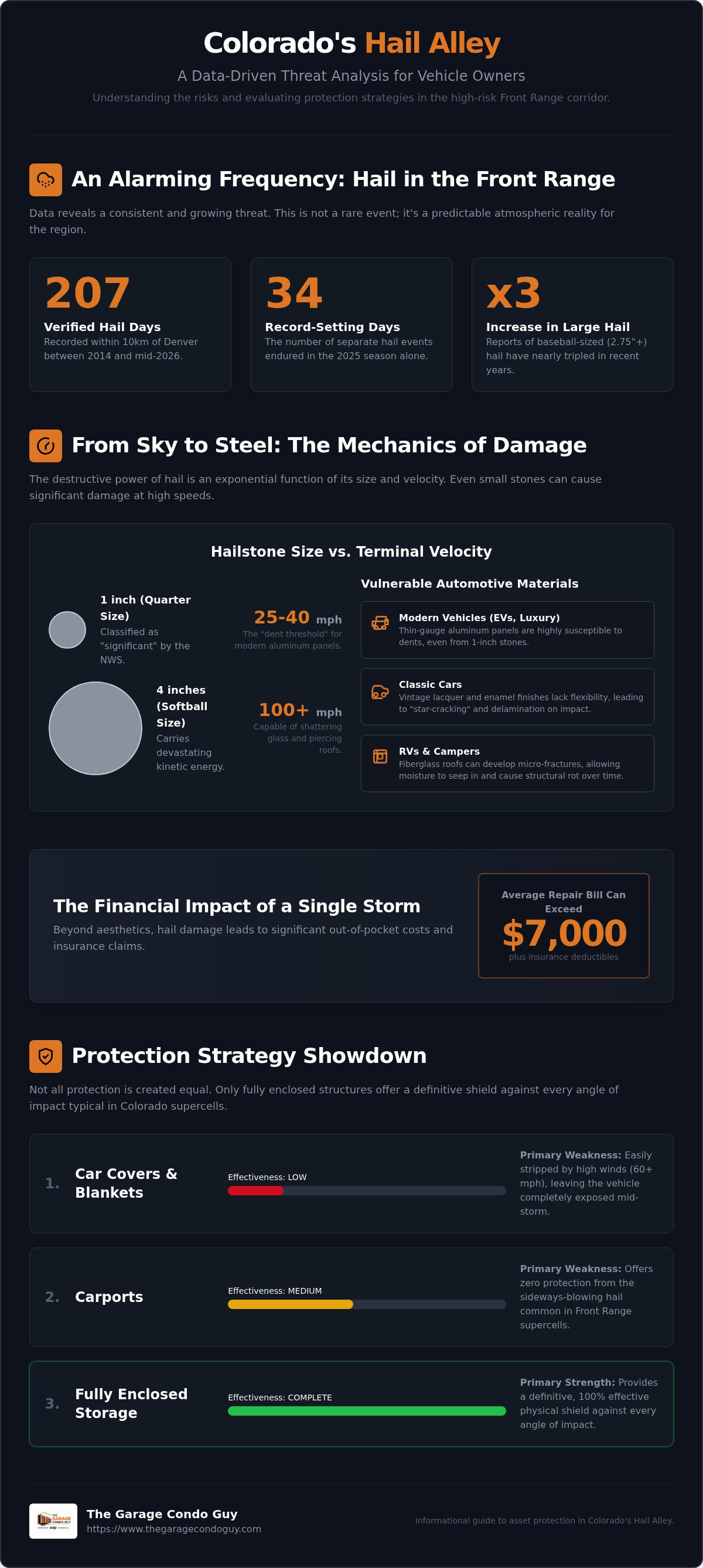
Between 2014 and mid-2026, Denver recorded 207 verified hail days within a ten-kilometer radius of the city center. In 2025 alone, the region endured 34 separate days of ice falling from the sky. If you own valuable vehicles in the Front Range, these aren't just weather reports; they're direct threats to your property. You likely already feel the seasonal anxiety that arrives every April, knowing that a single storm can lead to repair bills exceeding $7,000 or insurance deductibles that consume your liquid cash.
This guide provides a data-driven look at why our geography creates a literal "Hail Alley" and examines the specific mechanics required to shield automotive investments. You'll understand the physics behind impact damage and why standard car covers frequently prove inadequate against 1.5-inch stones. We will also analyze the cost-efficiency of various protection methods, from temporary shields to the specialized enclosed storage units now defining the Colorado market. By the end, you'll have a clear strategy to move your vehicles out of the line of fire for good.
Table of Contents
The Science of Hail: Why the Front Range is 'Hail Alley'
To understand the risks to your assets, we must look at The Science of Hail, which defines this phenomenon as precipitation in the form of balls or lumps of clear ice and compact snow. Unlike snow or sleet, it forms exclusively within supercell thunderstorms. These storms feature powerful updrafts that suspend ice crystals in freezing altitudes. As they cycle through these layers, they accumulate moisture that freezes instantly. They eventually fall when they become too heavy for the updraft to support.
Meteorological Factors in Colorado
Warm, moist air from the Gulf of Mexico travels north and hits the elevated terrain of the Rocky Mountains. This interaction triggers rapid convection. Colorado's high altitude plays a critical role. In lower elevations, smaller stones often melt into rain before hitting the ground. Here, the distance between the freezing level and the surface is shorter. This allows ice to reach your car in a solid, destructive state. This specific geography creates "Hail Alley," a high-risk corridor spanning Nebraska, Wyoming, and the Colorado Front Range.
Hailstone Classification by Size
Stones range from pea-sized (0.25 inch) to grapefruit-sized (4.5 inches). The National Weather Service classifies anything 1 inch or larger as "significant." In recent years, reports of baseball-sized ice have nearly tripled in the Front Range. This increase in size correlates directly with the rising intensity of supercell storms across the high plains. Even smaller stones can cause functional damage when propelled by high winds.
The Denver-Boulder corridor sees a frequency of events far above the national average. Between 2014 and 2026, Denver recorded 207 verified storm days within 10 kilometers of the city. The 2025 season set a record with 34 active days. By late August 2026, Colorado had already experienced 76 separate storm days statewide. This isn't just bad luck; it's a predictable atmospheric reality for the region.
The Mechanics of Damage: Velocity and Kinetic Energy
Understanding the physics of a storm explains why insurance premiums for Front Range drivers are rising. When a stone falls, it accelerates until it reaches a specific speed. A one-inch stone typically travels at 25 to 40 mph. A four-inch stone can exceed 100 mph. This velocity determines the force transferred directly to your vehicle's hood, roof, or glass upon impact.
Terminal Velocity and Impact Force
Terminal velocity is the constant speed reached when air resistance equals gravitational pull. Unlike rain, which breaks apart upon contact, hail remains a solid mass of ice. This solid state allows it to retain massive kinetic energy. The relationship between size and damage is exponential. Doubling the diameter of a stone doesn't just double the damage; it significantly increases the mass and the resulting impact force.
Vulnerability of Modern vs. Classic Materials
Modern automotive engineering prioritizes weight reduction and fuel efficiency. Many new EVs and luxury sedans utilize thin-gauge aluminum panels. This material is highly susceptible to localized impact. One-inch stones serve as the "dent threshold" for these modern surfaces. Even if the paint remains intact, the underlying metal deforms easily under the pressure.
Classic cars face different risks. Vintage lacquer and enamel finishes lack the flexibility of modern clear coats. High-velocity impacts often lead to "star-cracking" or delamination of the paint. RV owners must monitor fiberglass roofs closely. Even if a stone doesn't punch through, it creates micro-fractures. These flaws allow moisture to seep into the substrate, leading to structural rot over time. Automotive glass is also at risk. High-speed impacts cause internal micro-cracks that weaken the windshield. A simple temperature shift can cause a sudden, full-width crack weeks after the storm. If you're looking to consult on asset protection strategies, understanding these physical limits is the first step.
Evaluating Protection Strategies: Enclosed Condos vs. Temporary Shields
Protection strategies vary widely in their efficacy against Front Range ice. While multi-layer covers or "hail blankets" are common, they frequently fail during high-wind events. If a 60 mph gust strips a cover mid-storm, your vehicle is left completely exposed. Carports offer a roof, but they provide zero protection from the sideways-blowing stones typical of Colorado supercells. Only a fully enclosed structure provides a definitive physical shield against every angle of impact.
Comparing Mitigation Methods
Choosing the right method requires analyzing specific variables. Consider how these common solutions perform under pressure:
Car Covers: High failure rate in wind. They offer minimal impact absorption for stones larger than one inch.
Carports: No lateral protection. They fail to stop ice propelled by horizontal winds and offer no UV or dust mitigation.
Enclosed Garage Condos: 100% wind and impact resistance. These units provide a controlled environment that eliminates weather-related depreciation.
The Limitations of Insurance
Insurance policies cover financial restoration, but they don't preserve an asset's history. For collectors, a "total loss" payout rarely accounts for the loss of matching numbers or original paint. Colorado insurers are also shifting toward percentage-based deductibles, often ranging from 1% to 5% of the total insured value. This makes recurring hail damage an expensive cycle even with comprehensive coverage.
Beyond immediate storm protection, specialized units offer long-term benefits. You can Maintain Your Classic Car's Value with Climate-Controlled Storage to prevent seals from drying and paint from fading. To secure a permanent, deeded solution for your high-value vehicles, reach out for specialized buyer representation.
Securing Assets in High-Risk Front Range Locations
Certain Front Range municipalities face higher risks than others. Lakewood, Aurora, and Commerce City sit directly in the path of frequent hail cycles due to their specific topography and convection patterns. For collectors in these zones, the priority is securing a physical barrier that exceeds standard residential building codes. Ownership in developments like Denver Garage Condos or units in Longmont and Superior provides a strategic advantage for asset preservation. These locations offer deeded property rights, giving you permanent control over your storage environment.
Local Real Estate as a Protective Shield
Standard self-storage often utilizes light-gauge materials that buckle under pressure. Specialized garage condos use heavy steel frames and Class 4 impact-rated roofing systems. These structures are engineered to withstand the kinetic energy of four-inch stones. Expert representation is necessary to evaluate the structural integrity of these storage assets. We analyze site plans and construction specifications to ensure a unit meets the required defensive standards for your specific vehicle collection.
Next Steps for Asset Owners
Start by assessing your current risk profile. Review local zip code data to identify the hail storm frequency in your specific neighborhood. If your current location lacks a reinforced structure, begin a search for specialized storage in the Front Range. Focus on developments with proven wind and impact resistance. You can Contact The Garage Condo Guy for buyer representation to identify units with the most robust construction in high-risk zones. Moving your vehicles into a dedicated, deeded facility is the only way to eliminate weather-related depreciation entirely.
Defending Your Automotive Portfolio Against Front Range Storms
Protecting high-value vehicles in the Front Range requires more than a standard insurance policy. Atmospheric data from 2024 through 2026 confirms it. Hail remains a constant threat to automotive assets in Colorado's high-risk corridors. Understanding the physics of terminal velocity and the limitations of temporary covers is the first step toward effective mitigation. Moving to a proactive ownership strategy ensures your collection remains protected. It stops physical damage and weather-related depreciation. We maintain an exclusive focus on garage condo assets across Denver, Longmont, and Commerce City. As an affiliate of Loop Commercial Real Estate, our expertise allows us to identify units with the structural integrity required to withstand the region's most severe supercells. You can secure your collection with expert buyer representation to find a permanent, deeded storage solution. Taking control of your storage environment preserves the provenance and finish of your vehicles. We look forward to helping you secure a professional-grade facility.
Frequently Asked Questions
How big does hail have to be to dent a car?
Stones reaching one inch in diameter, roughly the size of a quarter, typically mark the threshold for visible automotive damage. Modern vehicles often utilize thin-gauge aluminum panels that deform under less pressure than vintage steel. While smaller pea-sized stones might only impact the clear coat, one-inch ice falling at 25 to 40 mph creates localized dents that require professional Paintless Dent Repair (PDR) services.
What is the 'Hail Alley' in Colorado?
'Hail Alley' is a meteorological corridor in the central United States where hail occurs with the highest frequency. In Colorado, this zone covers the entire Front Range, including Denver, Boulder, and Longmont. The region averages three to four catastrophic storms annually. This high activity results from the interaction between cold air from the Rockies and warm, moist air from the Gulf of Mexico, creating intense supercell thunderstorms.
Do car covers actually protect against 2-inch hail?
Standard multi-layer car covers and padded blankets rarely provide adequate protection against two-inch stones. At that size, ice reaches speeds exceeding 60 mph, delivering kinetic energy that easily compresses the padding and deforms the underlying metal. These covers are designed for smaller precipitation and UV protection. During severe Colorado storms, high winds often strip these covers away, leaving the vehicle entirely exposed during the peak of the storm.
How much does hail damage reduce a vehicle's resale value?
Visible damage significantly impacts a vehicle's market price, often requiring repairs between $3,000 and $7,000 for severe cases. For luxury or classic cars, even high-quality repairs can diminish value if the original paint is compromised or if the claim appears on a history report. If a vehicle is declared a total loss, it receives a salvage title. This drastically lowers the market price and complicates future insurance coverage for the asset owner.
What is the best way to protect an RV from hail in Denver?
Fully enclosed, structural storage provides the only 100% effective method for protecting an RV. Unlike standard carports, which leave the sides of the vehicle exposed to wind-blown ice, enclosed garage condos deliver a physical shield from all angles. This is critical for RVs, as fiberglass roofs frequently micro-crack during hail events. These fractures allow moisture to infiltrate the substrate, leading to structural rot that owners often miss until it is too late.


Comments