Denver Climate-Controlled Storage for Classic Car Value
A vintage Porsche 911 sitting in a standard Denver garage for just one winter can lose thousands in resale value before the engine even turns over. Colorado's low humidity and rapid temperature swings act as silent killers for collector vehicles. To Maintain Your Classic Car's Value with Climate-Controlled Storage, you must address the atmospheric chemistry unique to the Front Range. You already know that dry rot and fluctuating temperatures are your primary enemies when housing a high-value asset in the Mountain West. It is a constant battle to keep seals from cracking and metal from corroding.
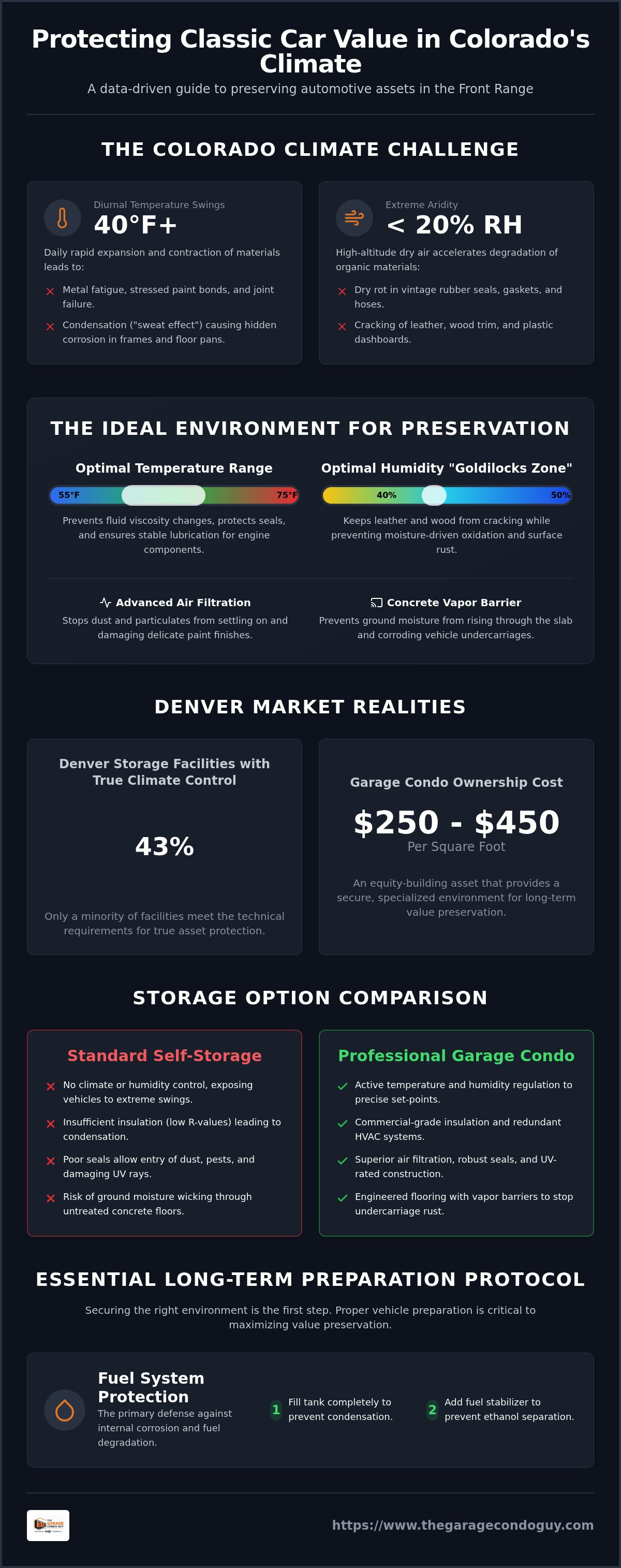
This article provides a data-driven look at how specialized environments prevent mechanical degradation and protect your vehicle's market position. You'll discover the specific technical requirements for humidity regulation and the current market variables for specialized storage. We'll also examine why only 43% of Denver's storage facilities offer true climate control and how garage condo pricing, currently ranging from $250 to $450 per square foot, impacts your long-term maintenance costs and investment strategy.
Table of Contents
The Colorado Climate Challenge: Protecting Classic Car Value
Denver's climate is a relentless opponent for vintage steel. Diurnal temperature swings frequently hit 40 degrees in a single day. This rapid cycle forces metal to expand and contract constantly, stressing paint bonds and structural joints. In non-insulated spaces, these shifts create a sweat effect. Warm air hits cold metal. Condensation settles into frame rails and floor pans. This hidden moisture is a primary cause of corrosion in Colorado vehicles.
Preserving a vehicle is different than just parking it. Automobile preservation focuses on keeping components in their original state. High-altitude air often drops below 20% relative humidity. This environment accelerates dry rot in vintage rubber seals and brittle leather interiors. If you want to Maintain Your Classic Car's Value with Climate-Controlled Storage, you must stabilize these variables. Stable environments protect the investment by ensuring every gasket and rubber hose remains pliable. Original Condition certifications often depend on a documented history of stable storage.
Atmospheric Risks in the Front Range
Carbureted engines face unique hurdles here. Fluctuating temperatures cause fuel to expand and evaporate. This leaves behind gummy deposits in older fuel systems. High-altitude UV intensity also poses a threat. Units with poor seals or non-UV-rated windows allow solar radiation to bleach upholstery and degrade plastic dash pads. It's a constant cycle of stress that depreciates your asset every day it sits unprotected.
Professional Denver garage condos eliminate these risks through superior insulation and climate management. When you're evaluating a storage space, consider these vital factors:
Seal integrity on all entry points to block dust and UV rays.
Insulation R-values that can withstand 40-degree shifts.
Active humidity regulation to keep interiors from cracking.
Technical Requirements for Climate-Controlled Automotive Storage
Precision is everything when you want to Maintain Your Classic Car's Value with Climate-Controlled Storage. You aren't just looking for a roof. You need a laboratory-grade environment. Ideal temperature set-points fall between 55°F and 75°F. Keeping this range constant prevents fluid viscosity changes that can lead to seal failure or poor lubrication during occasional start-ups. Sudden cold snaps in Denver can thicken oil and coolant. A steady climate ensures your engine is ready the moment you turn the key.
Humidity is the second critical pillar. Maintaining 40-50% relative humidity is the 'Goldilocks zone' for high-end assets. This level is high enough to keep leather and wood trim from cracking, yet low enough to prevent surface rust on exposed chrome. Following specific Technical Requirements for Climate-Controlled Automotive Storage ensures your vehicle doesn't suffer from the moisture-driven oxidation common in the Front Range. It's about creating a stable micro-climate that ignores the chaos of Colorado weather.
Air quality and floor construction also play vital roles. High-quality systems use specialized filters to stop dust and particulates from settling on delicate paint finishes. Additionally, professional facilities utilize vapor barriers within the concrete flooring. This prevents moisture from rising through the slab and settling on your undercarriage; it stops rust before it starts.
Standard Storage vs. Climate-Controlled Condos
Traditional self-storage often lacks the insulation R-values required for asset protection. Professional Denver garage condos utilize commercial-grade insulation and HVAC redundancy. If one system fails, a backup takes over. This level of security is non-negotiable for significant collections. If you're looking for a facility that meets these rigid standards, reach out for a consultation to see what's currently available in the Front Range.
Essential Preparation for Long-Term Value Preservation
Securing a facility is only half the battle. To Maintain Your Classic Car's Value with Climate-Controlled Storage, you must follow a rigorous intake protocol. Start with the fuel system. In Colorado's dry climate, internal tank corrosion occurs when air pockets allow condensation to form during transport or temperature shifts. It's essential to fill your tank completely and add a stabilizer to prevent ethanol separation. This protects your fuel lines and carburetors from expensive restoration costs.
Tire preservation is equally critical. Vintage rubber compounds are prone to flat-spotting if left stationary for months. Use specialized tire cradles or place the vehicle on jack stands to relieve pressure on the suspension and sidewalls. Don't overlook your electrical needs. Ensure your storage unit provides dedicated 110V power for a permanent trickle charger connection. Without a steady maintenance charge, 6V and 12V batteries will sulfate and fail. These preparation steps work in tandem with environmental controls to Maintain Your Classic Car's Value with Climate-Controlled Storage, ensuring mechanical integrity matches the cosmetic finish.
Front Range locations, especially those near open space, face pest risks. Field mice can destroy a bespoke interior in days. Seal your exhaust pipes and air intakes with steel wool or specialized plugs to block entry points.
The Concours Preparation Checklist
A true collector-grade storage strategy includes a full detail. Apply a high-quality carnauba wax to create a barrier against settling particulates. If your vehicle uses a 6V system, consider battery isolation; however, modern 12V systems usually benefit more from smart maintenance charging. For owners with larger fleets, including motorhomes, reviewing RV Storage Condos Front Range can provide insights into managing high-utility vehicle collections.
Proper preparation ensures your car exits storage in the same condition it entered. If you need a facility that offers the power and security required for these steps, contact a specialized advisor today to explore premium options in Denver and Longmont.
Garage Condos as a Value-Preservation Asset
Renting a standard storage unit is a recurring expense with zero return. Ownership shifts that dynamic entirely. A garage condo functions as a tangible real estate asset that can appreciate while you Maintain Your Classic Car's Value with Climate-Controlled Storage. This model provides permanent stability for your collection. You control the environment, the access, and the high-level security. Professional facilities feature gated perimeters, 24/7 video surveillance, and industrial-grade fire suppression. These features far exceed the protection found in most residential garages.
Customization is a significant advantage of deeding your space. Owners frequently build out mezzanines for offices or install specialized climate zones for sensitive mechanical components. Documented history is vital in the collector market. Vehicles with a documented history of storage in professional condos often command higher resale prices at auction. Buyers view 'condo-stored' as a badge of meticulous care. It proves the vehicle avoided the extreme temperature swings and low-humidity risks prevalent in the Denver area.
Investment Costs and Variables in Colorado
Market pricing in the Front Range is driven by location and specific unit amenities. New garage condo projects currently range from $250 to $450 per square foot. For instance, Unit 310 in Lakewood offers 1,134 sq. ft., including a 270 sq. ft. mezzanine. Unit 206 in the same development provides 1,300 sq. ft. with a 300 sq. ft. finished mezzanine. Proximity to major hubs like Boulder or Lakewood typically pushes prices toward the higher end of the spectrum. You can explore more about Car Storage Investment Opportunities to understand why these spaces are evolving into versatile flex assets. Variables like HVAC redundancy, RV support stations, and luxury owner clubhouses also influence the final cost per square foot.
Securing Your Automotive Legacy in the Front Range
Protecting a collector vehicle in Denver requires more than a standard garage door. You've seen how Colorado's extreme humidity drops and 40-degree temperature shifts can compromise mechanical integrity and cosmetic finish. By adhering to strict atmospheric set-points and rigorous preparation protocols, you can Maintain Your Classic Car's Value with Climate-Controlled Storage while avoiding the high costs of premature restoration. Transitioning from a rental unit to a deeded garage condo converts a monthly expense into a secure real estate asset with industrial-grade protection. It's the most effective way to ensure your investment remains protected against the unique atmospheric risks of the Mountain West.
As a specialist in Front Range garage condo transactions with the backing of Loop Commercial Real Estate, I focus exclusively on high-value automotive and RV assets. My expertise covers the specific needs of the local scene, from Denver to Longmont. Professional guidance ensures your collection remains in concours condition for maximum resale potential. Contact The Garage Condo Guy for Front Range specialized storage solutions to secure your facility today. Your collection deserves an environment as meticulously engineered as the vehicles themselves.
Frequently Asked Questions
What is the difference between climate-controlled and heated storage for cars?
Climate-controlled storage manages both temperature and humidity, whereas heated storage only prevents freezing. For vehicles, humidity management is vital to prevent rust and dry rot. Heated-only units can actually accelerate drying in Colorado's already low-humidity air. True climate systems use HVAC to keep relative humidity in the 40-50% range, protecting leather and wood trim from becoming brittle.
Does Colorado's low humidity affect classic car interiors?
Yes, Colorado's humidity often drops below 20%, which is dangerously low for organic materials. This environment causes leather seats to shrink and crack while wood-grain dashboards may warp or split. To Maintain Your Classic Car's Value with Climate-Controlled Storage, you must keep interiors in a stabilized environment. Proper humidity prevents natural oils from evaporating, preserving the original condition status of your asset.
How much does a climate-controlled garage condo cost in the Denver area?
Pricing typically falls between $250 and $450 per square foot across the Front Range. Total costs vary based on unit size and finished amenities like mezzanines or custom HVAC upgrades. While standard car storage rentals average $168 per month in Denver, ownership involves a larger capital investment into a deeded real estate asset. This ensures permanent access to a specialized environment.
Is climate-controlled storage necessary if I only store my car during winter?
Winter is actually the most critical time for climate control in Denver due to rapid temperature swings. These 40-degree diurnal shifts cause metal to expand and contract, leading to condensation and hidden frame rust. Even short-term exposure to these cycles can degrade mechanical seals and gaskets. Utilizing a specialized facility ensures your vehicle remains in a steady, dry micro-climate during the year's harshest months.
Can I customize the climate settings in a garage condo?
Most deeding models allow owners to Maintain Your Classic Car's Value with Climate-Controlled Storage by installing or adjusting unit-specific HVAC systems. While the building might have a base temperature, individual units often feature dedicated thermostats and humidity regulators. This allows you to set precise levels for specific assets, such as keeping a higher humidity for a pre-war vehicle with extensive wood framing.


Comments