Installing Vehicle Lifts in Denver Garage Condos
Colorado is the 4th largest market for garage condos in the U.S., with 1,950 units across 43 developments as of 2026. With local units averaging $235 per square foot, the goal for most owners isn't just floor space; it's maximizing vertical potential. You've likely looked at those 16 to 22-foot ceilings and asked: Can I Install a Vehicle Lift? It's the best way to double your storage, but the answer depends on more than just overhead clearance.
We agree that guessing on structural integrity is a risk no collector should take. This educational guide provides a data-heavy roadmap for your due diligence, covering Denver’s 2024 International Building Code and the ANSI/ALI ALCTV safety standards required for legal installation. We'll examine requirements for concrete slab thickness, which typically ranges from 3.5 to 6 inches, and how to verify HOA governing documents. You'll get a clear checklist to confirm 14-foot door clearances, 220-volt power availability, and how these modifications impact your long-term resale value.
Table of Contents
Critical Measurements: Ceiling Height and Clearances
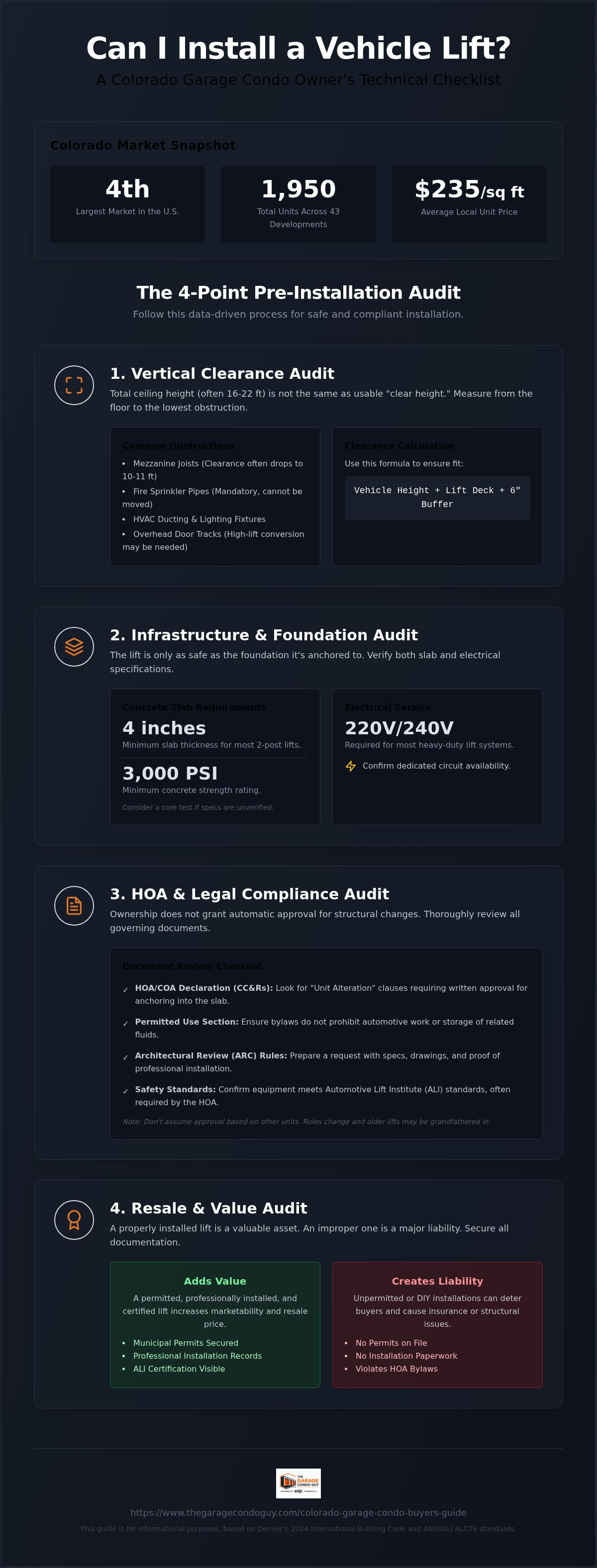
Clear height defines the actual usable vertical space from the concrete floor to the lowest hanging obstruction. In many Colorado developments, the architectural ceiling might reach 20 feet, but your operational clearance is often much lower. You must measure to the bottom of the lowest rafter, sprinkler pipe, or mezzanine joist. When asking, "Can I Install a Vehicle Lift?" your first step's calculating the total stack. Use this formula: vehicle height + lift deck height + a 6-inch safety buffer. Standard overhead doors in the Front Range typically range from 12 to 14 feet, which dictates what you can drive in, but not necessarily what you can stack.
The Mezzanine Factor
Mezzanines are a major draw in the Denver market, yet they create a vertical bottleneck. While the main bay offers soaring heights, the clear height under a mezzanine is typically limited to 10–11 feet. This is sufficient for low-profile sports cars on specialized Vehicle Lifts, but it won't clear a lifted truck or a full-sized SUV. Verify the exact usable clearance before committing to a 2-post or 4-post system. Structural support pillars can also restrict the arm swing of a 2-post lift, which may force an awkward orientation that consumes valuable floor space.
Obstructions Beyond the Ceiling
Ceiling height isn't a flat plane. Denver building codes require fire sprinkler lines in most new developments, and these pipes sit below the rafters. They're mandatory and cannot be moved. You should also verify the drop of HVAC ducting and LED lighting fixtures. If your unit features a 14-foot door, ensure the track system doesn't interfere with the lift when the door is open. High-lift track conversions are a common solution here, moving the door closer to the roofline to reclaim space. For more details on unit specs, refer to the Colorado Garage Condo Buyer’s Guide.
HOA Regulations and Unit Governing Documents
Owning the unit doesn't grant total autonomy over structural changes. Before you purchase, your first priority is analyzing the HOA or COA Declaration of Covenants, Conditions, and Restrictions (CC&Rs). Look specifically for "Unit Alteration" clauses. Most Denver-area developments require written approval for any installation that anchors into the concrete slab. You must also review the "Permitted Use" section. If you plan on performing maintenance, ensure the bylaws don't prohibit automotive work or the storage of hazardous fluids like waste oil and brake fluid.
Noise ordinances and floor-loading limits are often buried in the fine print. When asking, "Can I Install a Vehicle Lift?" you should prepare an Architectural Review Committee (ARC) request. This packet typically requires technical drawings, equipment specs, and proof of professional installation. To streamline this process, you can find specific community requirements in our Colorado Garage Condo Buyer’s Guide.
Liability and Insurance Requirements
Associations prioritize the community's master insurance policy. They often mandate that all equipment meets safety standards set by the Automotive Lift Institute (ALI). You may be required to provide a certificate of insurance from your installer. This protects the HOA from liability if a failure occurs that impacts the building's structural integrity or fire suppression systems.
Verifying "Other Owners" Precedent
Don't assume a lift is permitted just because your neighbor has one. Rules change. Older installations might be grandfathered in under expired bylaws. You must verify the current regulations by reviewing the most recent official HOA meeting minutes and the current board-approved rules and regulations document.
Infrastructure Needs: Concrete Slabs and Electrical Service
Your garage condo's physical foundation is the ultimate deciding factor for vertical storage. While standard overhead doors in Colorado typically range from 12 to 14 feet, the concrete beneath them must be equally robust. Most 2-post lifts require a minimum of 4 inches of 3,000 PSI concrete to ensure structural stability. When asking, "Can I Install a Vehicle Lift?" you must verify these specs against the vehicle lift installation and service safety standards. Many units within Denver Garage Condos are built with these requirements in mind, but verifying the slab's PSI is a non-negotiable step in your due diligence.
Verifying Slab Integrity
Blueprints don't always tell the whole story. If slab thickness is unverified in the original documents, use a concrete core test or ground-penetrating radar. This is vital for identifying post-tension cables. Drilling into a post-tensioned slab can compromise the entire building's structural integrity, leading to catastrophic failure and massive repair costs. You'll want to confirm the slab is traditional reinforced concrete before any anchors hit the floor.
Electrical Upgrades
Professional 4-post and 2-post systems generally require 220V or 240V service. Before finalizing a purchase, you should ask: Can I Install a Vehicle Lift? in this specific bay without upgrading the entire panel? Check your unit’s panel for open breaker slots that can support a dedicated 30A or 50A circuit. Some high-end industrial developments even offer 3-phase power for heavy-duty industrial equipment. Remember that most HOAs require formal approval for electrical work that ties into common elements. To ensure your potential unit meets these technical hurdles, download the Colorado Garage Condo Buyer’s Guide for a full infrastructure checklist.
Buying or Selling a Unit with Lift Upgrades
Resale value in the Colorado garage condo market often hinges on specialized utility. For car collectors, a pre-installed lift is a premium feature that simplifies their move. However, sellers should realize that permanent lift posts can limit the market for RV or boat owners who require unobstructed floor space. When a potential buyer asks, "Can I Install a Vehicle Lift?" they're usually looking for a turn-key solution. Sellers must provide complete permitting records and professional installation receipts to prove the modification meets local Denver or Commerce City building codes. Missing documentation can stall a closing or force a seller to remove the equipment entirely.
The Value of Pre-Installed Lifts
Purchasing a unit with an existing system can save a buyer between $5,000 and $10,000 in equipment and labor costs. This assumes the lift is a high-quality, ALI-certified model. You must verify that the current installation aligns with the community's latest safety standards and was formally approved by the HOA. Working with a Front Range garage condo specialist ensures these technical details aren't overlooked. Whether you are buying or selling, the question "Can I Install a Vehicle Lift?" should be answered with documented evidence of structural and legal compliance.
Preparing for Inspection
During the inspection phase, the focus shifts to infrastructure health. Examine the concrete slab around the anchor bolts for stress fractures or spiderweb cracking, which could indicate a PSI failure or improper anchoring. It's also a good time to evaluate the total environment. Checking for overall unit health, including the roof and climate control systems, ensures the lift operates in a stable, moisture-free space. For a complete list of 20 key due-diligence questions to ask before closing, refer to the Colorado Garage Condo Buyers Guide. This resource helps you verify that every structural and legal box is checked before any money changes hands.
Securing Your Vertical Storage Strategy
Adding a lift to your Denver garage condo requires balancing technical specs with legal boundaries. You've learned that clear height under a mezzanine is often just 10 to 11 feet, regardless of the 20-foot ceiling peak. You also know that verifying 4-inch concrete thickness and 220V power is essential before anchoring any equipment. When you ask, "Can I Install a Vehicle Lift?" the answer lives in the HOA bylaws and your unit’s structural blueprints. Success depends on verifying these variables before the inspection period ends.
As a specialist focused exclusively on car and garage condos, I provide the Front Range expertise needed to vet these properties. You can access our comprehensive 20-question due-diligence checklist to ensure your potential unit is lift-compatible. Get the Full Colorado Garage Condo Buyer’s Guide to navigate your purchase with confidence. Your high-capacity collectors' space is ready for takeoff.
Frequently Asked Questions
Does a vehicle lift require a special building permit in Colorado?
Yes, most municipalities like Denver or Commerce City require permits for structural modifications and electrical additions. The 2024 International Building Code mandates that lifts be ALI certified. You'll need to submit plans to the local building department and obtain HOA Architectural Review Committee approval first. Don't skip this step; unpermitted work can complicate future insurance claims or resale during your exit strategy.
Can I install a lift in a unit with a mezzanine?
You can install a lift under a mezzanine if the clear height allows for your specific vehicle and equipment stack. Typical clear height under Front Range mezzanines is limited to 10–11 feet. This usually restricts you to low-profile cars rather than tall trucks. When asking "Can I Install a Vehicle Lift?" always measure the clearance to the lowest structural joist or sprinkler pipe.
What is the minimum concrete thickness for a 2-post car lift?
Most manufacturers require a minimum of 4 inches of reinforced concrete with a 3,000 PSI rating for a standard 2-post lift. Heavier commercial-grade systems often demand 5 to 6 inches for safety. You should verify your slab's specifications through original blueprints or a core test. Never drill into a post-tension slab; this can cause structural failure across the entire garage condo building in Superior or Lakewood.
Do I need 220V power for a car lift in my garage condo?
Yes, most hydraulic vehicle lifts require a dedicated 220V or 240V circuit. When you ask "Can I Install a Vehicle Lift?" you must also check your panel capacity. While some portable units run on 110V, they're slower. Many developments in Longmont or Centennial offer 50-amp service or 3-phase power as standard. Always confirm your unit's panel has space for a new 30A or 50A breaker.
Will a vehicle lift increase the property value of my car condo?
A professionally installed and permitted lift increases appeal to the car collector market, which often supports a higher resale price. It effectively doubles your storage capacity in high-demand areas like Aurora or Golden. However, it may narrow the market for RV owners if the posts obstruct floor space. Keep all professional installation receipts and permit copies to prove the unit's value during a future appraisal or sale.
General educational information only. Verify property-specific zoning, HOA/COA documents, taxes, financing, and legal requirements before purchase or installation.


Comments