Smarter Denver Business Storage: Garage Condos vs Warehouses
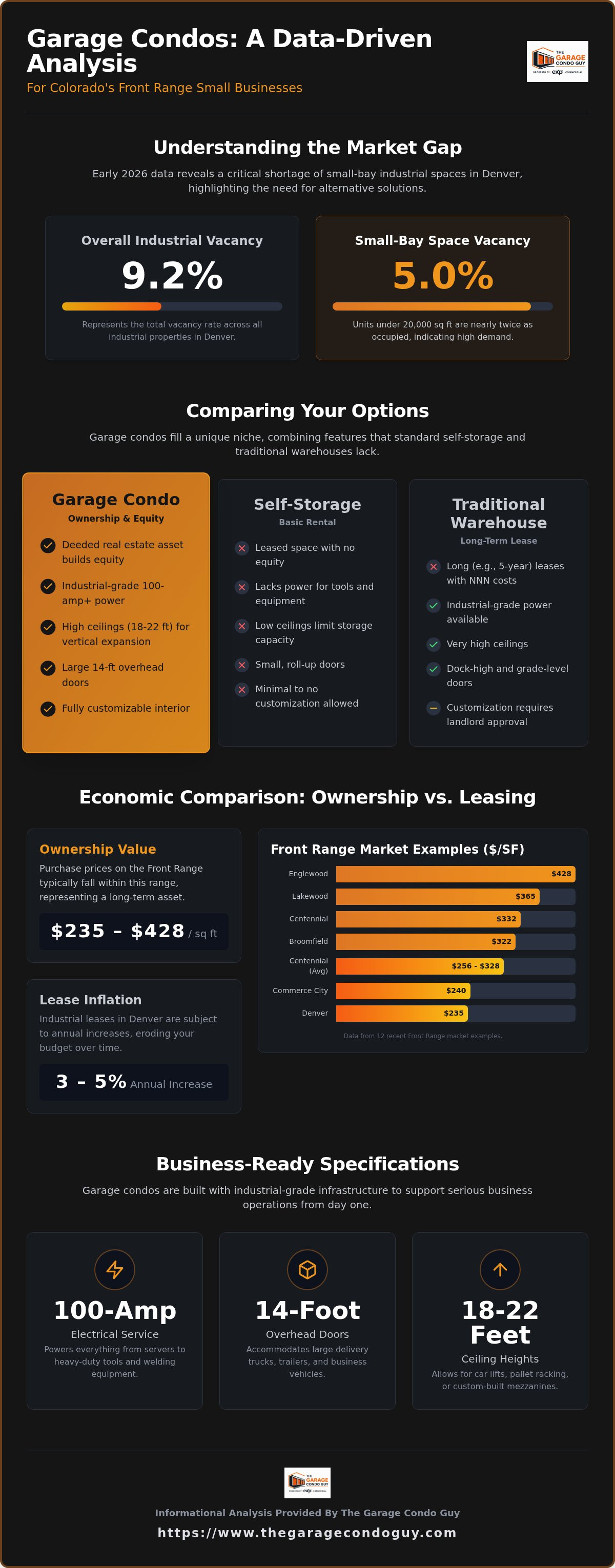
Did you know that while Denver's overall industrial vacancy rate reached 9.2% in early 2026, the vacancy for small-bay spaces under 20,000 square feet is nearly half that at just 5%? This scarcity makes finding small business storage units—the smarter alternative to traditional warehouses—a top priority for Front Range entrepreneurs. You've likely felt the pressure of rising lease rates and restrictive landlords who limit your operational freedom. It's difficult to justify high monthly overhead when it builds zero equity for your company.
This analysis provides a data-driven look at why garage condos are replacing standard industrial leases. We'll examine concrete market data, including price points ranging from $235 per square foot in Denver to $428 per square foot in Englewood. You'll learn how these assets provide the industrial-grade power and climate control that standard self-storage lacks. We'll also compare the value of ownership against traditional Class B and Class C warehouse leases. This is your guide to securing a customizable, high-utility workspace that functions as a legitimate business asset.
Table of Contents
Defining the Garage Condo as a Small Business Flex Solution
A garage condo is an individually owned industrial unit within a larger complex, typically zoned for storage or light industrial use. It's a distinct category. Standard self-storage lacks the power for tools. Traditional warehouses demand five-year leases. This model bridges the gap. A garage condo is a deeded real estate asset with industrial-grade utilities. Business owners find that small business storage units: the smarter alternative to traditional warehouses offer superior control. These spaces function as What is Flex Space?, blending professional office areas with rugged workshop capabilities.
Common Business Uses in the Front Range
Entrepreneurs across the Colorado Front Range leverage these units for specific operational needs. E-commerce brands utilize them as fulfillment centers for rapid inventory turnover. Trade contractors like plumbers and electricians use them as secure shops for high-value equipment. Professional firms often require climate-controlled environments for sensitive electronics or document archives. These Longmont garage condos and similar Denver garage condos serve as strategic hubs for businesses moving between city centers and growing suburbs.
Technical Specifications for Business Readiness
Readiness depends on utility infrastructure. A 100-amp electrical service is the standard baseline for modern operations. It powers everything from server racks to welding equipment. Loading is handled via 14-foot overhead doors, accommodating large delivery trucks or trailers. Ceiling heights typically range from 18 to 22 feet. This height is intentional. It provides ample clearance for car lifts or custom mezzanines. Such features allow businesses to expand vertically while maintaining a compact, efficient ground-level workflow.
Economic Comparison: Industrial Leases vs. Garage Condo Ownership
Industrial leases are unpredictable. Landlords pass through variable operating costs in Triple-Net (NNN) agreements, leaving tenants vulnerable to tax hikes and maintenance spikes. Ownership replaces these fluctuating expenses with predictable HOA fees and property taxes. Small business storage units: the smarter alternative to traditional warehouses provide the stability needed for long-term fiscal planning. Current 2026 data shows new construction targeting $275 to $425 per square foot. Consider these 12 actual Front Range market examples:
Denver: $235/SF ($475,000)
Centennial: $332/SF ($359,000)
Centennial: $328.13/SF ($525,000)
Centennial: $325.64/SF ($635,000)
Centennial: $302/SF ($350,000)
Centennial: $283/SF ($263,400)
Centennial: $256/SF ($492,000)
Commerce City: $240/SF ($264,000)
Broomfield: $322/SF ($285,000)
Broomfield: $315/SF ($378,000)
Lakewood: $365/SF ($350,000)
Englewood: $428/SF ($325,000)
Variables Impacting Unit Valuation
Location drives value. Denver units differ in price from Commerce City options based on proximity to major transit corridors. Local zoning ordinances also dictate use cases, impacting demand. Premium features like floor drains, mezzanine-ready heights, and dedicated HVAC systems increase the initial buy-in. They reduce future retrofit costs for specific business needs.
Asset Appreciation vs. Lease Inflation
Lease inflation in Denver averages 3-5% annually. Ownership fixes the primary occupancy cost. Over a 10-year horizon, the Total Cost of Occupancy (TCO) often favors the buyer due to equity accumulation and tax advantages. You can request a detailed market analysis to see how these figures apply to your specific zip code.
Zoning and Regulations for Small Business Operations
Understanding local codes is vital for operational success. Small business storage units: the smarter alternative to traditional warehouses must meet specific zoning criteria to be legally compliant. Light industrial zoning typically permits fabrication and assembly. Commercial zoning focuses more on retail and office use. You've got to verify which designation applies to your unit before signing a contract. HOAs often enforce strict covenants on signage and external storage. They also monitor customer traffic levels to maintain the property's professional environment.
The "Can I Work Here?" test is simple but critical. Passive storage involves dropping off goods and leaving. Active use means running a business inside the unit for hours. Most developments allow active use but forbid residential living. You can read more about Can You Live in a Garage Condo? Front Range Regulations to understand these boundaries. If you need specialized help, consult with a specialist about local zoning to ensure your business plan remains compliant.
Local Front Range Zoning Nuances
Dacono and Longmont have emerged as business-friendly hubs. These municipalities offer clearer paths for small-bay industrial use. In contrast, Superior and Boulder maintain rigorous permit processes. If you plan to install a mezzanine for office space, expect structural engineering reviews. You'll need specific permits to satisfy local building departments.
Compliance and Safety Requirements
Safety standards are non-negotiable for business owners. Fire suppression systems are required if your inventory qualifies as high-piled storage. Units used as primary workspaces must also meet specific occupancy limits. Bathroom access is another requirement for units where employees spend full shifts. These technical details ensure your workspace is both legal and safe for daily operations.
Strategic Selection: Finding the Right Business Storage Unit
Selecting small business storage units: the smarter alternative to traditional warehouses requires a rigorous vetting process. You don't just buy a shell; you buy an operational environment. Step 1: Conduct a site-specific utility audit. Confirm that the 100-amp service supports your heavy equipment. Verify high-speed internet availability for real-time inventory management. Check for existing plumbing or stub-outs for future restrooms. These details prevent expensive retrofits after closing.
Step 2: Review the HOA's financial health. Request the most recent reserve study. A well-funded association prevents sudden special assessments for common area repairs or roof maintenance. Step 3: Evaluate accessibility for delivery vehicles and large equipment. Measure the turning radius for 24-foot trailers to ensure your supply chain remains efficient. Step 4: Consult a specialist to navigate the niche garage condo buyer representation process. Expert guidance ensures the industrial zoning matches your specific business use.
Maximizing ROI Through Customization
Customization transforms a basic unit into a high-utility asset. Mezzanine builds are the most effective way to increase value. They often double your usable square footage, providing dedicated office space above your workshop area. High-grade epoxy flooring and LED lighting upgrades create a professional, client-facing environment. These improvements differentiate your space from standard industrial bays and improve long-term asset value. Professional finishes matter when hosting partners or high-value customers.
Next Steps for Colorado Business Owners
Current availability in Longmont and surrounding Front Range cities changes rapidly. Start your search by defining your specific industrial requirements. Do you need a floor drain? Is a 14-foot door high enough? Once you have your specifications, you can Contact The Garage Condo Guy for a consultation on business storage assets to begin viewing properties that match your specific criteria.
Securing Your Industrial Workspace in the Front Range
Transitioning to an owned facility represents a significant step toward long term operational stability. Ownership fixes your primary occupancy costs, protecting your company from the annual rent escalations common in Denver's industrial sector. By focusing on utility audits and local zoning verification, you can ensure your new facility supports future growth. Small business storage units: the smarter alternative to traditional warehouses offer the customization and asset equity that traditional leases cannot provide. These units allow you to establish a professional headquarters on your own terms.
Navigating 2026 market trends and complex Front Range zoning requires a high level of specialized expertise. Expert buyer representation helps you avoid the common pitfalls of restrictive HOA covenants or insufficient power grids. If you're ready to move beyond the limitations of standard industrial leases, it's time to take the next step. Secure your business's future. Contact the Front Range garage condo specialist today. Your ideal flex space is within reach.
Frequently Asked Questions
Can I legally run a small business out of a garage condo in Denver?
Yes, you can legally operate a business if the unit's zoning designation permits your specific use. Most garage condos in Denver are situated in commercial or light industrial zones that allow for assembly, e-commerce fulfillment, and professional services. You must verify the specific local zoning map and ensure your activities don't violate HOA covenants regarding customer traffic. This makes small business storage units: the smarter alternative to traditional warehouses for those needing more than a home office.
What is the average square foot price for a garage condo in the Front Range in 2026?
In 2026, Front Range garage condo prices typically range from $275 to $425 per square foot for new construction. Established units in areas like Centennial or Lakewood have recently sold for between $235 and $428 per square foot depending on the level of customization. Factors such as proximity to I-25, mezzanine additions, and specialized utility hookups like floor drains will significantly influence the final purchase price of these assets.
Do garage condos have high-speed internet and power for office work?
Most modern garage condos are designed for business readiness, but utility availability varies by development. A 100-amp electrical service is the standard baseline for operating tools and office equipment simultaneously. While many new Front Range projects include fiber internet hookups, you must conduct a site-specific audit to confirm speed and reliability. These utilities are essential for units used as inventory hubs or professional workshops. Always verify that the infrastructure supports your specific mezzanine plans.
How do HOA fees for industrial storage units compare to traditional warehouse CAM charges?
HOA fees are generally more predictable than the Common Area Maintenance (CAM) charges found in triple-net warehouse leases. While CAM expenses can fluctuate based on a landlord's actual costs for taxes and insurance, HOA dues are set by an association budget. These fees typically cover exterior maintenance, snow removal, and security. Small business storage units: the smarter alternative to traditional warehouses offer a fixed-cost structure that protects your bottom line from the sudden spikes common in leased spaces.
Are there financing options available for small businesses buying storage condos?
Small business owners typically explore commercial real estate loans or specialized SBA programs when purchasing industrial assets. Since these are deeded properties, they qualify for different lending structures than a standard lease or a residential mortgage. You should check with local Colorado lenders to see if your specific business use qualifies for owner-user financing. A specialist can help you gather the necessary property data to present to your bank for a formal appraisal and loan application.


Comments