Front Range Car Storage for Sale Prices, New Units vs Resales
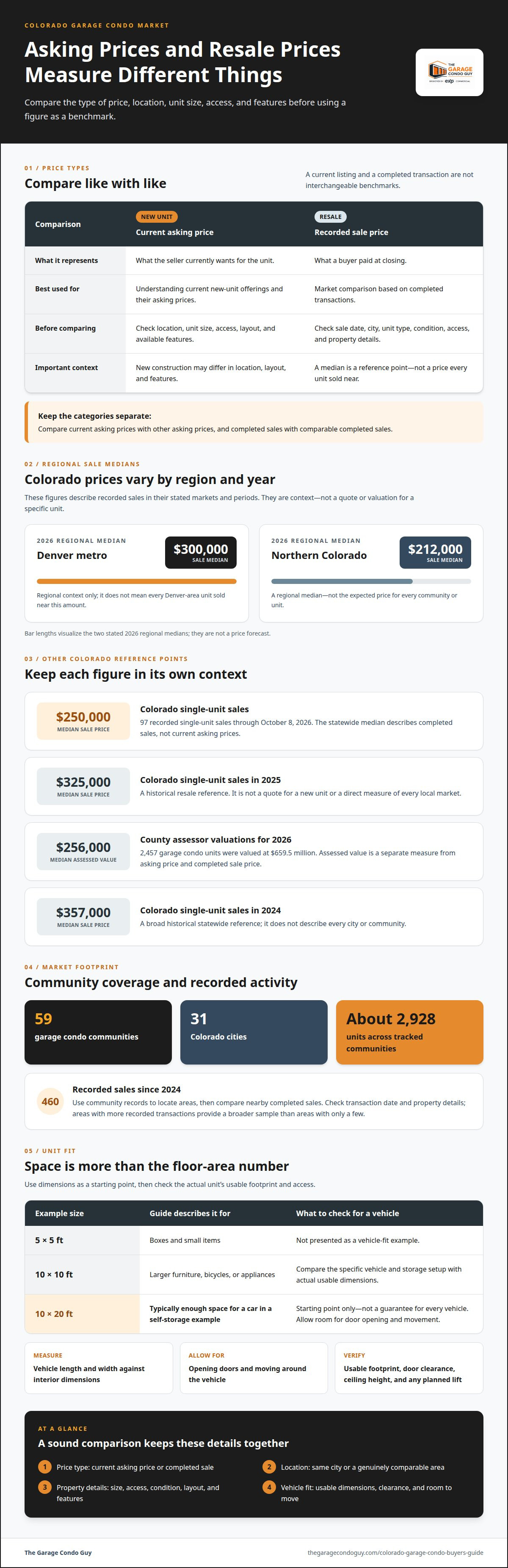
A Colorado garage condo’s median sale price was $250,000 through October 8, 2026. Regional medians show why location matters: in 2026, the Denver metro median was $300,000, compared with $212,000 in Northern Colorado. For Front Range car storage for sale, compare current new-unit asking prices with recorded resale prices, not as interchangeable figures.
Price is only one part of the decision. Unit size, access, and permitted use all affect which option makes sense for your car, collection, or other vehicles. A new unit and a resale may also be in different communities, so compare location and property details alongside the price.
This guide explains how to compare new-unit asking prices with resale prices, find garage condo communities and recorded Colorado sales, and assess regional differences. You’ll get a clearer basis for choosing a unit that fits your needs and comparing options across the Front Range.
Table of Contents
New-unit prices compared with resales
New-unit asking prices and resale prices measure different things. An asking price is what a seller currently wants; a recorded sale shows what a buyer paid at closing. Compare similar locations, unit sizes, access, and features before using either figure as a benchmark.
For context, Colorado garage condos had a $325,000 median single-unit sale price in 2025. That resale figure is useful for market comparison, but it is not a quote for a new unit. New construction can differ in location, layout, and available features. A fair comparison matches those details and separates current asking prices from completed transactions.
Start with the vehicle. A 10-by-20-foot self-storage unit typically provides enough space for a car. Storage-unit size guides also describe a 5-by-5-foot unit for boxes and small items, and a 10-by-10-foot unit for larger furniture, bicycles, or appliances. These examples help estimate space, but a garage condo’s usable dimensions and access are distinct considerations.
For vehicle storage, compare the car’s length and width with the unit’s interior dimensions, then allow room to open doors and move around it. The 10-by-20-foot example is a starting point, not a guarantee that every vehicle or storage setup will fit. A larger vehicle or extra equipment may require more usable floor area.
Zoning and land-use rules vary by Colorado city and county. A permit requirement for a detached garage does not establish the rules for every vehicle-storage facility or garage condo. Check the applicable land-use classification and project details for the specific property.
Investment risks also vary by property. Hail can expose vehicles and buildings to weather damage; flooding can affect access and structures; competition can influence buyer demand and resale prospects. Location, building condition, drainage, and nearby alternatives shape those risks. The Colorado garage condo buying guide offers a framework for evaluating these property-specific factors.
Garage condo communities and recorded sales
Colorado’s market has a wider footprint than a single city. The OGC National Database tracks 59 garage condo communities across 31 Colorado cities, with about 2,928 units. That count helps show where communities are concentrated, while recorded sales reveal which properties have changed hands.
The Colorado garage condo sales database recorded 460 sales since 2024. Through October 8, 2026, its records included 97 single-unit sales, with a median sale price of $250,000. These figures describe completed transactions, not current asking prices. A median also doesn’t mean every unit sold near that amount: size, location, condition, and property features can create a wide spread.
Use community records and sales data together. First, browse communities by city to identify areas with garage condos. Then compare recorded sales in the same area, focusing on individual-unit transactions. Check sale dates and property details before using a figure as a comparison. An area with more recorded transactions provides a broader sample than one with only a few.
Denver-area buyers can narrow their search by looking at communities in and around the metro, then comparing their locations and unit characteristics. The Colorado garage condo buying guide can help organize the property details to consider alongside sales records.
Historical data also needs context. Colorado’s single-unit median was $357,000 in 2024, but that statewide figure doesn’t describe every city or community. Treat it as a broad reference point, then look for comparable transactions near the specific property. Differences in access, layout, and the type of unit can make two sales in the same region poor matches.
For a practical comparison, record each sale’s city, transaction date, unit type, and available property details. Keep asking prices separate from closed-sale prices. This distinction makes community listings and recorded transactions more useful when evaluating Front Range options.
Garage condo prices by Colorado region
Colorado garage condo prices vary by region, so a statewide figure can hide important local differences. In 2026, the Denver metro median sale price was $300,000. Northern Colorado’s median was $212,000. For buyers comparing Front Range car storage for sale options, that regional gap offers useful context, but it doesn’t establish the price of a particular unit.
Compare locations before comparing numbers. Denver metro and Northern Colorado are broad areas, not identical markets. A unit’s community, size, condition, access, and features also affect how closely it matches another sale. For a Denver-area search, browse Denver garage condos alongside other local options.
Colorado county assessors valued 2,457 garage condo units at $659.5 million for 2026, with a median assessed value of $256,000 per unit. That assessment figure measures something different from a completed sale. Use it as a separate reference, not as a substitute for a region’s sale median or a unit’s asking price.
For a regional comparison, keep current asking prices, recorded sale prices, and assessed values separate. Compare properties in the same area and look for similar unit characteristics. This can help you judge how a listing relates to local sales without treating a statewide measure as a direct valuation.
Regional medians are most useful for setting context. A $300,000 Denver metro median doesn’t mean every Denver-area unit is priced near that amount; Northern Colorado’s $212,000 median likewise describes the region, not every community. A smaller sample of comparable sales can also make a local benchmark less representative.
When assessing Front Range car storage for sale, start with location, then compare unit details and transaction type. Differences between metro and northern markets offer a starting point. Specific features and comparable local sales add the context needed to assess an individual property.
How many vehicle storage spaces, garage bays, or square feet does each property offer?
A property’s total unit count and an individual unit’s capacity answer different questions. Colorado had 36 garage condo listings across 19 cities, with 111 or more units available, as of November 2026. Those market totals describe inventory, not how many vehicles fit inside each property or bay.
Read each listing for the individual unit’s interior dimensions, door clearance, and usable layout. A 10-by-20-foot footprint equals 200 square feet, but floor area alone doesn’t show whether a vehicle fits comfortably. Interior walls, storage equipment, and room to move around the vehicle all affect practical use.
Door height can decide whether a larger vehicle fits. A 14-foot garage door clears most enclosed trailers and Class C motorhomes. A 16-foot door clears a Class A motorhome. Match the opening to the vehicle’s height, rather than relying only on a listing’s stated bay or square footage.
Ceiling clearance matters for lifts. Lift clearance depends on the lift and vehicle, so check the required clear height before choosing a space. Measure the required clear space, not just the building’s overall height. Be sure to account for the vehicle and lift in the same fit assessment.
For a multi-bay property, distinguish the number of individual garage bays from the building’s total square footage. A listing may describe an entire property, several separate units, or one unit within a larger community. These descriptions are not interchangeable. Record unit count and dimensions separately when comparing properties.
A useful review follows four details: bay count, interior width and depth, door opening, and clear ceiling height. Then compare those measurements with the vehicle and equipment you plan to store. Use the Colorado garage condo buying guide to assess these property details before narrowing your options.
Sale values can complement a space comparison, but they do not establish bay count or usable floor area. Colorado garage condos had a $250K median sale price across 97 single-unit sales recorded through October 8, 2026. The median price of a single-unit garage condo sale in Colorado was $357K in 2024 and $325K in 2025; Colorado garage condos had 149 single-unit sales in 2025. County-assessed values for established garage condo units rose 25.8% from 2023 to 2025. The highest single-unit sale was $4,900,000, at Hayden Airport Garages in Hayden in August 2008.
The Garage Condo Guy
Evaluating garage condo properties and transactions involves considering a unit’s location, features, and fit for vehicle-storage needs. When comparing Front Range options, buyers can assess these details alongside regional medians. Owners preparing to sell can consider the property in its market context.
A specific property evaluation or sale involves looking beyond regional medians alone. Relevant considerations include the garage condo, its property details, and the transaction at hand.
Information about buying or selling a garage condo can include property details and transaction considerations.
Set Your Next Property Criteria
Before pursuing a property, decide what matters most: vehicle fit, location, ownership structure, or resale goals. A short list of priorities makes comparisons more focused and helps you assess options on the same terms. If you’re weighing Front Range car storage for sale, use broad market context to set criteria for a specific transaction.
When comparing garage condos, use these priorities to evaluate each property consistently. Consider how well an option fits your vehicle, preferred location, ownership needs, and resale goals.
Review the garage condo buyer’s guide for information to consider when comparing properties. A clear set of priorities gives you a practical place to begin.
Frequently Asked Questions
What kind of unit should I get?
Choose a unit based on your vehicle, intended use, and community rules. For an RV or boat, account for mirrors, rooftop equipment, turning clearance, and the full path through the door, not just the vehicle’s parked dimensions. Communities in Denver, Boulder, Longmont, and across the Front Range can differ in permitted uses and available utilities, so match the property documents and specifications to your plans.
What operating expenses, taxes, insurance, and maintenance costs should buyers expect?
Budget for property taxes, HOA or COA dues, insurance, utilities, routine maintenance, and possible special assessments. Garage condos are generally taxed as commercial real estate, so include that tax treatment in your ownership budget. Review community documents for dues, insurance responsibilities, and reserve information. Leasehold ownership may also involve ongoing land-lease payments. General educational information only. Verify property-specific zoning, HOA/COA documents, taxes, financing and legal requirements before purchase.
Which Front Range cities have car storage properties for sale, and where are they located?
Car storage properties are located in Centennial and communities in and around the Denver metro area.

Comments