Buy Car Storage Unit in Colorado for Secure Vehicle Access
Yes, a Denver storage unit can hold a car if its interior dimensions and entrance fit the vehicle. A 10-by-20-foot unit is the most common size for car storage and fits most sedans, crossovers, SUVs, and small trucks. Larger vehicles may need more room.
Look beyond size: security and access matter, too. If you plan to buy a car storage unit in Colorado, first distinguish an owned garage condo from rented vehicle storage. They are different arrangements.
This guide explains whether a unit can accommodate your car in Denver and what to weigh when assessing security and access. You’ll also see how ownership differs from renting and what factors shape the decision if you’re considering a purchase.
Table of Contents
What criteria can help you assess a car storage unit in Colorado?
Assessing a garage condo requires different considerations from renting ordinary self-storage. Start by defining your vehicle’s dimensions and how you’ll use the space. A collector who needs frequent access, for instance, may prioritize different features than someone seeking long-term parking. Clear priorities help you compare properties against your intended use.
Compare location, unit layout, vehicle access, and ownership details. In Colorado, you can narrow options to a specific market, then assess how each property fits your requirements. The Colorado garage condo buyer’s guide provides a relevant starting point for understanding this purchase category.
When assessing properties, consider these criteria:
Define your requirements: Identify your vehicle’s dimensions, access preferences, and intended use, then use those criteria to filter suitable garage condos.
Compare properties: Review location, layout, entry configuration, and property details side by side. A unit that fits the car still needs to work for your access routine.
Assess the features: Consider how the property’s features align with your priorities. For instance, a buyer storing a weekend vehicle may value convenient entry differently from someone storing a rarely used car.
Review the purchase: Evaluate the transaction details and whether the selected property remains aligned with your original requirements.
Before choosing a property, clarify whether you want an owned garage condo or rented storage. Buying means evaluating a real estate purchase; rental storage is a different arrangement. Keep that distinction in mind when comparing properties for your vehicle and intended use.
How much does a car storage condo or unit cost in Colorado?
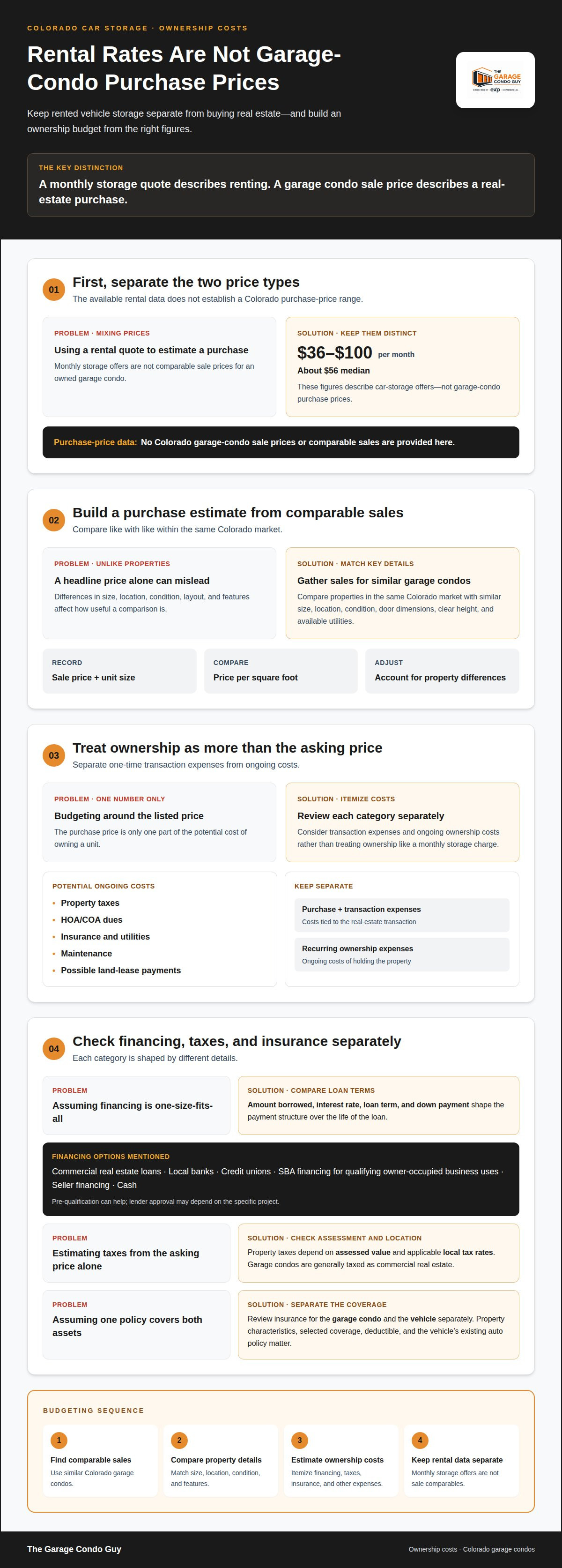
A garage condo purchase has a sale price; rented vehicle storage has a monthly charge. The available figures here do not provide Colorado garage-condo sale prices or comparable sales, so they cannot establish a purchase-price range. Car storage on the market typically ranges from $36 to $100 per month, with a median of about $56. Those figures describe storage offers, not the purchase price of an owned garage condo.
To estimate a purchase price, gather sale prices for comparable garage condos in the same Colorado market. Compare properties with similar size, location, condition, door dimensions, clear height, and available utilities. Record the sale price and unit size for each comparable, then compare prices per square foot and account for differences between the properties. The rental figures above cannot be used as purchase-price comparables.
Review costs beyond the asking price. Your budget may include transaction expenses and ongoing ownership costs, which are separate from the listed price. These can include property taxes, HOA/COA dues, insurance, utilities, maintenance, and any land-lease payments. Consider each cost separately rather than treating ownership as one monthly storage expense.
Separate ownership from rental: The $36-$100 monthly market range applies to car storage offers, not condo purchases.
Compare like with like: Match Colorado locations, unit sizes, and property features before evaluating sale prices.
Build a complete budget: Consider the purchase price alongside transaction and ongoing ownership expenses.
Check the intended use: A property’s layout and access features matter because they determine how well it serves your vehicle-storage needs.
For a purchase-price estimate, use comparable Colorado garage-condo sales and account for differences in size, location, and features. The Colorado garage condo purchase information is separate from rental-rate data, which cannot substitute for real estate sale comparisons.
What financing, property taxes, and insurance costs apply to buying a Colorado car storage unit?
Budget for more than the purchase price when evaluating a Colorado garage condo. Financing, property taxes, insurance, utilities, HOA/COA dues, maintenance, and possible land-lease payments are distinct cost categories. A rental rate is not an ownership expense, so keep it separate from the costs of owning the unit.
For financing, consider the amount borrowed, interest rate, loan term, and down payment. These terms shape your payments over the life of the loan. Buyers may explore commercial real estate loans, local banks, credit unions, SBA financing for qualifying owner-occupied business uses, seller financing, or cash. Pre-qualification can help, but lender approval may depend on the specific project. Include transaction expenses and ongoing property costs in your budget.
Property taxes depend on the assessed value and applicable local tax rates. The location and assessment therefore matter when estimating ownership expenses. Separate the asking price from the assessed value, then account for the property’s taxes. Garage condos are generally taxed as commercial real estate, and taxes are an ongoing ownership cost, not part of a rental-storage quote.
Review insurance for the property and the vehicle separately. Coverage for the garage condo and coverage for the vehicle address different assets, so don’t assume one policy covers both. The property’s characteristics, your selected coverage, and the deductible affect insurance costs. Also consider the vehicle’s existing auto policy.
Financing: Compare the loan amount, rate, term, and down payment to understand the payment structure.
Property taxes: Include the assessed value and applicable local rates in the ownership estimate.
Insurance: Distinguish coverage for the unit from coverage for the vehicle.
Overall budget: Keep purchase, financing, tax, insurance, and other ownership expenses in separate categories.
Separate one-time transaction expenses from recurring ownership costs when estimating the total budget. Financing, local assessments, insurance coverage, utilities, and HOA/COA costs can each affect the amount and timing of expenses.
How do Colorado car storage units compare with renting vehicle storage
Buying a garage condo and renting vehicle storage solve different needs. A purchase gives you ownership of a specific property; rental storage provides use of a space under a rental arrangement. In Denver, the listed average price for car vehicle storage is $173. Treat that figure as rental-market context, not a purchase price or ownership-cost estimate.
Renting can suit a temporary need or a vehicle you may move soon. It avoids buying real estate, but the space remains rented rather than owned. Buying a car storage unit in Colorado may suit someone seeking a dedicated property for longer-term use, but it also involves ownership expenses and a real estate transaction.
Compare the options against your likely timeline and access needs. A seasonal vehicle kept temporarily, for example, may fit a rental arrangement. If you expect to store a car in the same location for years, ownership may be worth evaluating. Compare the purchase price and ongoing ownership costs with rental charges, and consider how often you need access.
Time horizon: Match a short-term storage need to rental flexibility; assess ownership for a longer commitment.
Access routine: Compare how each option supports your expected visits and vehicle use.
Cost structure: Separate rental charges from a purchase price, financing, taxes, insurance, and other ownership expenses.
Property control: A condo is an owned property, while rented storage does not give you ownership of the space.
For a meaningful comparison, use the same evaluation period for both options. Add the rental charges over that period, then compare them with the garage condo’s ownership costs, including taxes, dues, insurance, utilities, maintenance, and any land-lease payments. Factor in how long you’ll store the vehicle and how often you need access. This helps distinguish a purchase from ongoing rental charges.
If ownership is the option you’re considering, use the Colorado garage condo buyer’s guide to evaluate your purchase.
The Garage Condo Guy
The Garage Condo Guy helps buyers assess garage condos as vehicle-storage properties and navigate a purchase through Garage Condo Buyer Representation. This service can help when you’re weighing ownership against renting, comparing unit features, or considering how financing and ongoing costs affect your decision. The focus is garage condos, not general self-storage rentals.
Owners preparing to sell can also use Garage Condo Seller Representation. The Garage Condo Guy represents buyers and sellers in garage condo transactions across the Front Range, helping align the property decision and transaction with your goals.
For help with a Colorado garage condo purchase or sale, contact The Garage Condo Guy.
Choose the next step that fits your plans
Before moving forward, decide what you need the property to do. A place to keep a vehicle, a longer-term real estate purchase, and an investment each call for a different evaluation. That purpose helps determine which details to examine most closely as you consider buying a car storage unit in Colorado.
If your decision involves investment potential as well as vehicle use, consider both purposes when evaluating the property. Keeping them distinct can help clarify which details matter to your plans as you assess a potential purchase.
The Colorado garage condo buyer’s guide addresses questions to consider when evaluating a property. Your priorities can help you determine which questions are most relevant to your intended use.
Frequently Asked Questions
Can you store a car in a storage unit in Denver, CO?
Yes. A Denver storage unit can hold a car if its interior dimensions and entrance accommodate the vehicle. For a purchased garage condo, distinguish ownership from rented self-storage: the label alone doesn’t establish what you own. Review the governing documents and permitted-use rules. Garage condos generally aren’t residential, and overnight stays may be restricted by zoning, building codes, or HOA/COA rules. These distinctions matter across Denver and the Front Range.
What size storage do I need for a car near Denver, CO?
Compact cars are commonly matched with 10-by-15-foot spaces; full-size cars with 10-by-20-foot spaces. Large pickups may need 10-by-30 feet. These sizes are starting points, not a substitute for measuring the vehicle and checking the actual entrance and clear interior height. Include mirrors and rooftop equipment in your measurements, then compare those dimensions with the specific Denver-area unit.
What sizes and features do Colorado car storage units offer?
Colorado garage condos range from spaces for cars to larger units for RVs, boats, or business storage. Many have overhead doors in the 12-14-foot height range, though designs vary by community. Standard door width is typically 12 feet, with options ranging from 10 to 18 feet. Utilities may include power, water, heating, or air-conditioning. Availability varies, and some utilities or alterations may require HOA/COA approval.
Are car storage units in Colorado sold as condos, commercial property, or storage spaces?
The label doesn’t establish the ownership structure. A garage condo or car condo may be a fee-simple condominium, where you own the unit and an interest in common elements, or a leasehold/land lease, which can involve ongoing ground rent. These properties are generally commercial or storage spaces, not residences. General educational information only. Verify property-specific zoning, HOA/COA documents, taxes, financing, and legal requirements before purchase.
What risks and resale considerations come with buying a car storage unit in Colorado?
Consider the unit’s condition, size, location, access, transaction expenses, financing, taxes, insurance, and any shared building costs. Compare similar properties; the material provides no basis for assessing resale prospects.


Comments