Car Condos Denver: 5 Things to Know Before You Buy
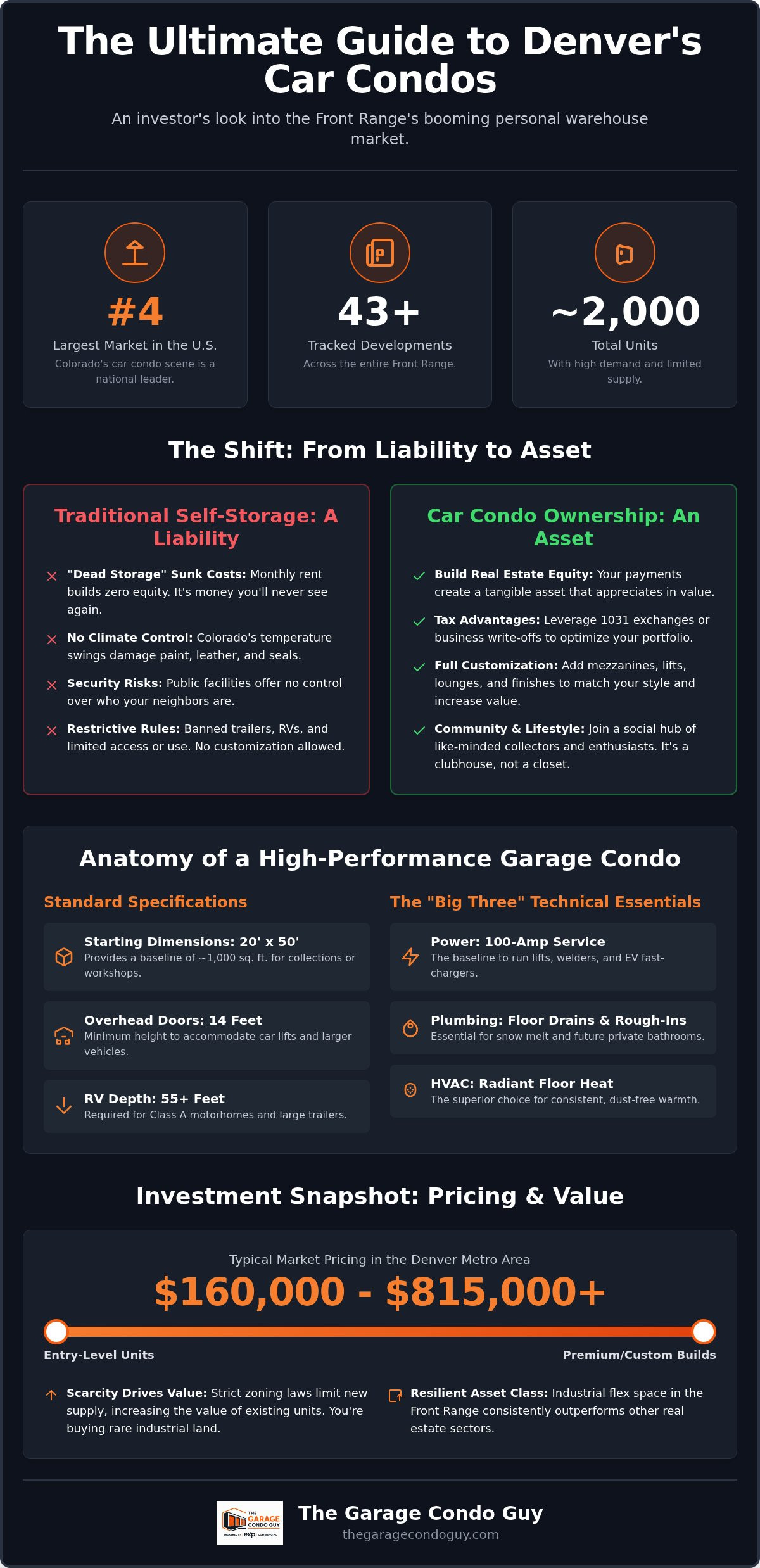
Did you know Colorado is officially the #4 largest market for car condos in the United States? With 43 tracked developments and nearly 2,000 units across the Front Range, the race for premium automotive space is on. If you're scouting car condos denver collectors are currently snapping up, you already know a standard home garage doesn't cut it. You need a secure, climate-controlled environment that protects your high-value assets from Colorado’s unpredictable weather and restrictive residential HOA rules.
It's frustrating to run out of space at home or face fines for parking your trailer in the driveway. We agree that your collection deserves better than a cramped, unheated corner. This guide will help you discover the essential factors to evaluate when buying a car condo to ensure your investment matches your lifestyle. We will preview the five critical things you must know before signing. This includes current market pricing ranging from $160,000 to over $815,000, hidden HOA costs, and the specific amenities that drive long-term appreciation in the Denver metro area.
Table of Contents
Why Denver Enthusiasts are Swapping Rental Units for Car Condos
Why are you still throwing money away on monthly rent? In 2026, the Denver industrial market is reaching a critical tipping point. For years, collectors settled for "dead storage" in windowless rental units. That era is over. Enthusiasts across the Front Range are pivoting toward car condos denver markets offer because they realize a storage unit is a liability, while a condo is an asset. These aren't just parking spots; they are high-performance lifestyle spaces that you actually own.
Think about your monthly rent check. It is a sunk cost that never returns a dime of value. Transitioning to condominium ownership allows you to capture real estate appreciation while securing a permanent home for your collection. You are building equity in a niche industrial asset class that has consistently outperformed traditional storage. In a market where five major projects have already sold out, waiting to buy is becoming an expensive mistake.
Beyond the balance sheet, there is the community factor. These developments are the new social hubs for Colorado car culture. Instead of a lonely, dusty storage unit, you get a private retreat. You are surrounded by like-minded collectors and entrepreneurs who share your passion. It is the difference between a closet and a clubhouse.
The Problem with Traditional Self-Storage
Most rental facilities are not built for high-value assets. A lack of climate control is a silent killer for classic car paint, leather, and rubber seals. Colorado’s extreme temperature swings can do more damage than a hail storm. Then there is the security risk. In a public facility, you have no control over who is renting the unit next to yours. Furthermore, cities like Denver, Boulder, and Lakewood are tightening municipal codes. They are effectively banning trailers and RVs from residential driveways, leaving owners with almost no quality options at home.
The Investment Case for Garage Condos
Scarcity drives value. Denver’s strict zoning laws make it incredibly difficult to find land for new car condos denver projects. This limited supply, combined with Colorado being the #4 largest car condo market in the country, creates a powerful case for appreciation. You aren't just buying a garage; you are buying rare industrial dirt.
Tax Advantages: Many owners leverage 1031 exchanges or business write-offs to optimize their portfolios.
Asset Class Growth: Industrial flex space in the Front Range remains one of the most resilient real estate sectors in 2026.
Customization: Unlike a rental, you can add mezzanines, custom flooring, and high-end cabinetry to increase your unit's resale value.
The Anatomy of a High-Performance Garage Condo
What exactly are you buying when you scout car condos denver developers are currently building? It is more than a parking spot. It is a "personal warehouse." Most units in the Front Range are sold as fee-simple real estate. This gives you a deeded interest in the property. You own the air rights and the interior space. Some projects operate on a long-term leasehold interest, but fee-simple remains the gold standard for those seeking a tangible real estate asset that builds equity over time.
Standard dimensions usually start around 20' x 50', providing roughly 1,000 square feet of space. This is perfect for a four-car collection or a small workshop. However, if you are hauling a 45-foot Class A motorhome, you need a custom footprint. Look for units with 14-foot overhead doors and at least 55 feet of depth. The "Personal Warehouse" concept is taking over because it treats the garage as a flexible industrial flex space rather than a simple storage box.
Essential Technical Specifications
Your unit's performance depends on "The Big Three": Power, Plumbing, and HVAC. A 100-amp electrical service is the baseline for 2026. You need this capacity to run car lifts, weld, or fast-charge an EV collection. Plumbing is equally critical. Ensure the unit has a floor drain to handle Colorado snow melt. Many premium units now include rough-ins for private bathrooms and utility sinks. For climate control, radiant floor heat is the superior choice. It provides consistent warmth without circulating dust or allergens that can settle on your vehicles.
Premium Upgrades and Customization
The shell is just your canvas. Mezzanines are the most popular upgrade in Denver. They allow you to loft an office or a lounge above your vehicles, effectively doubling your square footage. Industrial-grade epoxy flooring is another must-have. It protects the slab from chemical spills and creates a showroom aesthetic. Finally, integrated smart tech is essential. High-speed fiber and remote-access security systems allow you to monitor your assets from your phone. If you are struggling to compare the spec sheets of different developments, garage condo buyer representation can help you identify which units offer the best "bones" for your buck.
Scouting the Front Range: Denver, Longmont, and Beyond
Where you park is a strategic decision. The Front Range isn't a monolith, and the market for car condos denver enthusiasts are chasing varies wildly by zip code. If you are looking in Denver proper, prepare for a battle. Demand is at an all-time high, while supply is virtually stagnant. This scarcity means prices in the city core stay elevated, often pushing collectors to look toward the suburbs for better value and more modern amenities.
The North Corridor is the current epicenter of growth. Communities like Longmont, Dacono, and Frederick are seeing a surge in new developments. These areas offer the "Personal Warehouse" footprints collectors crave but at a slightly more accessible entry point than urban Denver. For those who prioritize mountain access, the Western Edge is the gold standard. Lakewood and Golden are premium markets because they serve as the gateway to the foothills. If you want your collection staged for a weekend drive up Lookout Mountain, you will pay a location premium here.
Superior and Boulder cater to a specific niche. These developments often feature high-end hobbyist spaces with strict architectural standards. They aren't just garages; they are designed to look like luxury commercial storefronts. They often include expansive clubhouses and social calendars that justify their higher price per square foot.
Location-Specific Zoning and Use Rules
Zoning is the most overlooked detail in a transaction. Can you run a business out of your unit? You must distinguish between "Hobbyist" and "Flex Business" zoning. Some developments strictly prohibit commercial activity, while others are designed specifically for entrepreneurs. Also, don't plan on moving in. Most Denver-area HOAs have ironclad rules against overnight stays. These are industrial assets, not residential lofts. Finally, consider your proximity to major arteries. A unit is only as good as its access to I-25, US-36, or C-470. If it takes forty minutes to reach a highway, the novelty of the space will wear off fast.
New Developments vs. Resale Opportunities
Buying at the "dirt" stage allows for maximum customization. You can influence the mezzanine layout and pick a unit with the best turning radius for your trailer. However, you are at the mercy of construction timelines. The resale market moves even faster. These units rarely hit the open MLS. They trade through private networks and insider handshakes. To find these off-market gems, you need a Front Range garage condo specialist who knows which owners are ready to liquidate before the listing goes live.
The Ultimate Buyer’s Checklist: Due Diligence for Car Condos
You have found a unit that looks perfect on paper. Now comes the hard part. Due diligence in the car condos denver market is different than a standard residential home inspection. You are evaluating an industrial asset with specific lifestyle requirements. Don't skip the fine print. It costs you later. Follow this five-step checklist to ensure your unit is a high-performance investment rather than a maintenance headache.
Step 1: Verify the "Use Clause." Does the development allow your specific hobby? Some HOAs prohibit heavy mechanic work or commercial detailing. If you plan to run a business, ensure the zoning supports flex-industrial use.
Step 2: Review the HOA Financials. Denver HOA fees have surged 20% to 25% since 2022. Check the reserve study. Are there healthy funds for roof replacement and pavement maintenance? You don't want a massive special assessment six months after closing.
Step 3: Check Door Heights. It sounds simple. It isn't. If you have a Class A motorhome or a high-profile trailer, you need a minimum 14-foot overhead door. Measure the clearance yourself.
Step 4: Assess the Power Drop. We previously discussed the 100-amp baseline. Verify that this power is actually delivered to your specific unit's panel. If you need 220V for a car lift or a welder, confirm the capacity before you sign.
Step 5: Inspect the Mezzanine Structure. Many resales feature custom lofts. Is the mezzanine permitted? Is it load-bearing? An unpermitted structure can kill your resale value or lead to city code violations.
Reviewing the Covenants, Conditions, and Restrictions (CC&Rs)
Common pitfalls are hidden in the bylaws. Many Denver-area garage condos strictly prohibit outside parking. This means your daily driver or guest's car cannot sit in the alleyway overnight. Check the signage rules if you're a small business owner. Can you put your logo on the door? Finally, review the guest policy. If you want to host private club meetups or social events, ensure the CC&Rs don't treat your "man cave" like a quiet library.
Financial and Legal Considerations
Financing car condos denver lenders offer usually falls under commercial terms. Expect different down payment requirements than a traditional mortgage. You also need specialized insurance. You must cover both your personal property (the cars) and the structural interior. Finally, remember that Colorado classifies these as commercial or industrial property. This impacts your property tax assessment differently than residential real estate. If these technical hurdles feel overwhelming, investment advisory for garage condos provides the specialized expertise needed to navigate the fine print.
Navigating the Denver Market with a Specialized Broker
Standard residential agents are great for finding a three-bedroom ranch. They are often lost when it comes to the technical nuances of car condos denver investors are currently targeting. These deals are commercial transactions. They require a deep understanding of industrial zoning, mezzanine load-bearing specs, and complex CC&Rs. If your agent is looking for "comparable sales" on a residential grid, they are missing the specialized industrial data that actually determines value in this niche.
The Front Range market is incredibly tight. Many of the best units in Superior or Dacono never reach the public eye. They trade through "Insider Access." Because we are exclusively focused on this niche, we know which owners are ready to exit before they list. We represent buyers and sellers with a level of focus that broader competitors simply lack. If it’s already on the MLS, you’re likely already too late.
Negotiating these contracts is a different beast. You aren't dealing with a standard home purchase agreement. Commercial contracts have different earnest money expectations and due diligence timelines. We ensure your interests are protected during the feasibility period. We look for the red flags that a generalist might miss, from inadequate floor drainage to looming HOA assessments that could impact your ROI.
The Loop Commercial Real Estate Advantage
Operating under Loop Commercial Real Estate gives us a data-driven edge. We leverage deep industrial market insights to ensure you aren't overpaying for a shell. Our network includes local lenders who actually understand the garage condo asset class. We also connect you with vetted mezzanine contractors and epoxy specialists. This ensures your unit is "lifestyle-ready" from day one. Whether you need a space for a vintage Porsche collection or a base for your small business, we tailor the search to your specific footprint and power requirements.
Your Next Steps in the Front Range
Ready to stop browsing and start owning? The first step is a specialized consultation. We will map out your needs across Lakewood, Longmont, and the rest of the Front Range. We set up custom alerts that hit your inbox the moment a unit matches your criteria. This keeps you ahead of the competition in a market where supply is always lagging behind demand. Contact The Garage Condo Guy today to secure your spot in Colorado’s most exclusive automotive communities.
Secure Your Front Range Automotive Legacy
Buying into the car condos denver market is a strategic move for both your lifestyle and your portfolio. You are no longer just looking for storage. You are securing a high-performance real estate asset. Success requires more than a quick tour. It demands rigorous due diligence on technical specs and a deep understanding of local zoning laws. In a market where inventory is low and demand is skyrocketing, having an expert in your corner is the only way to stay ahead.
Don't leave your investment to a residential generalist. As a specialized broker at Loop Commercial Real Estate, I track the latest trends across Longmont, Lakewood, and Denver. I provide the insider access needed to find off-market units that never hit the public MLS. Find your perfect car condo with The Garage Condo Guy and stop settling for dead storage. Your collection deserves a space that matches its value. Let's get started today.
Frequently Asked Questions
Can I live in my car condo in Denver?
No, you cannot live in your unit. Most car condos denver developments are zoned for industrial or commercial use, which strictly prohibits overnight residency. While you can build a luxury mezzanine with a lounge and TV, municipal codes and HOA bylaws are ironclad about this being a non-residential space. It’s a retreat for your collection, not a primary home.
How much do car condos typically cost in the Front Range?
Pricing varies based on size and location, but the core market currently ranges from $160,000 to over $815,000. Entry-level units in communities like Windsor or Commerce City sit on the lower end. Premium units in Centennial or Superior often command the highest prices per square foot due to high demand and luxury social club amenities.
Is a car condo a good real estate investment for 2026?
Yes, 2026 is a strong year for this asset class. With Colorado ranking as the #4 largest market in the U.S., demand continues to outpace supply. Industrial flex space remains resilient, and the scarcity of new developments in the Front Range suggests long-term appreciation potential for well-located units. It’s a tangible asset that builds equity over time.
Are there HOA fees for garage condos, and what do they cover?
Yes, expect monthly HOA fees generally ranging from $300 to $600. These fees are vital for protecting your investment. They typically cover the master insurance policy for the building structure, roof maintenance, snow removal, and common area upkeep like pavement and security gate repairs. These costs have risen recently due to increased insurance premiums across Colorado.
Can I run a small business out of my car condo?
It depends entirely on the specific zoning and "Use Clause" of the development. Some projects are strictly for hobbyists, while others are designed as flex spaces for small businesses. Always verify that your business activity aligns with local municipal codes and the development’s CC&Rs before purchasing. Some units are perfect for low-impact professional services or inventory storage.
Do car condos in Denver have climate control?
Most modern units include climate control as a standard feature. Radiant floor heat is the preferred method for Colorado winters because it keeps the slab warm without blowing dust onto your vehicles. Some luxury car condos denver developments also offer full HVAC systems for summer cooling, which is essential for protecting sensitive automotive finishes and leather interiors.
What is the difference between a car condo and a personal warehouse?
The terms are often used interchangeably, but a "car condo" usually implies a lifestyle-focused community with social amenities like clubhouses. A "personal warehouse" is often a more utilitarian industrial flex space. Both typically offer the same fee-simple ownership model, allowing you to own the real estate rather than throwing money away on monthly rent.
How do I finance the purchase of a garage condo in Colorado?
Financing usually requires a commercial loan rather than a traditional residential mortgage. Lenders in Colorado typically look for different down payment structures and debt-to-income ratios for these niche industrial assets. Many buyers also choose cash transactions or 1031 exchanges to streamline the closing process. It is best to work with a lender familiar with industrial flex properties.


Comments