What Is a Garage Condo? Front Range Buying Guide
A garage condo’s marketing name doesn’t tell you what you actually own. If you’re searching “What Is a Garage Condo? Everything You Need to Know Before Buying,” start with the deed and governing documents, not the listing description. The label can refer to different ownership arrangements, and the details determine your rights and obligations.
A dedicated place for vehicles, equipment, or projects may sound straightforward. But a unit that looks right online may not fit your vehicle, have the utility access you need, or permit your intended use. Garage condos in Colorado may be fee-simple condominium units or leasehold properties. Confirm the structure and terms for the specific property.
This guide covers ownership, unit dimensions, HOA or COA rules, utilities, zoning, financing, taxes, inspections, and resale. Use it to organize your due diligence, then confirm property-specific details with appropriate professionals. General educational information only. Verify property-specific zoning, HOA/COA documents, taxes, financing and legal requirements before purchase.
Table of Contents
What Is a Garage Condo? Understand the Property Behind the Name
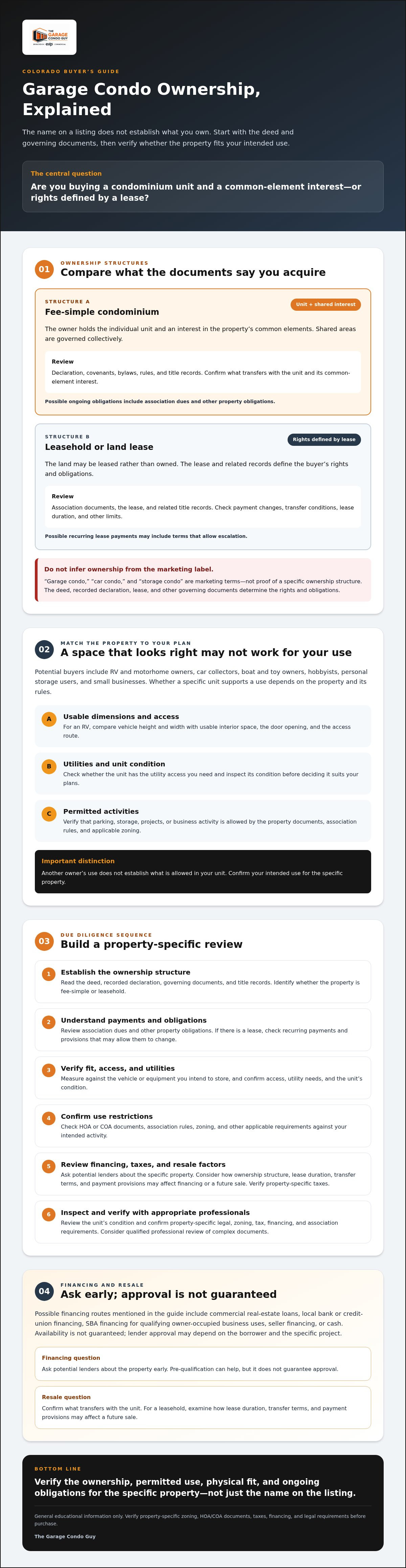
A garage condo is a unit within a property governed as a condominium, though the specific ownership arrangement can vary. In a fee-simple condominium, the owner holds the unit and an interest in common elements. Those shared areas are governed collectively. This is the basic distinction in condominium ownership.
“Garage condo,” “car condo,” “storage condo,” and similar labels are marketing terms, not proof of a particular ownership structure. The deed, recorded declaration, and other governing documents determine what you own and which rights and obligations apply. For Colorado-specific due diligence, consult The Garage Condo Guy.
What might ownership include?
With fee-simple condominium ownership, you own the individual unit and hold an interest in the property’s common elements. A leasehold or land-lease arrangement is different: the land may be leased rather than owned, and the documents may require recurring payments or allow those payments to increase. Don’t infer the structure from a listing label. Identify it in the recorded documents before assessing costs, rights, financing, or resale. That distinction is central to What Is a Garage Condo? Everything You Need to Know Before Buying.
Who might consider a garage condo?
Potential buyers include RV and motorhome owners, car collectors, boat and toy owners, hobbyists, personal storage users, and small businesses. Whether a particular unit supports parking, storage, projects, or business activity depends on its dimensions, utilities, zoning, and association rules. Another owner’s use does not establish what’s allowed in your unit.
If you’re considering a unit for an RV, compare the vehicle’s height and width with the usable interior space, door opening, and access route. Verify that the intended storage or activity is permitted by the property’s documents and applicable rules.
Garage Condo Ownership: Compare Fee-Simple and Land-Lease Structures
The key question is what the buyer legally acquires. The governing documents, not the marketing label, establish the buyer’s rights. A fee-simple condominium interest and a leasehold or land-lease interest aren’t interchangeable.
What documents establish the ownership arrangement?
Review the recorded declaration, covenants, bylaws, and rules alongside the title documents. For a leasehold, examine the lease for payment changes, transfer conditions, and other limits. Confirm that the unit and any common-element interest match the records. These materials can be complex, so consider qualified professional review rather than treating a general guide as legal advice. For building-condition due diligence, the Commercial Property & Inspection Association checklists offer a separate inspection reference.
Which ownership questions affect financing and resale?
Possible financing routes include a commercial real-estate loan, local bank or credit-union financing, SBA financing for qualifying owner-occupied business uses, seller financing, or cash. Availability isn’t guaranteed, and lender approval may depend on the specific project and borrower. Ask potential lenders about the property early. Pre-qualification can help, but it doesn’t guarantee approval. Lease terms may also affect financing and resale, depending on the documents and lender.
The Colorado garage condo buyer guide outlines ownership and due-diligence questions. What Is a Garage Condo? Everything You Need to Know Before Buying starts with verifying the structure. General educational information only. Verify property-specific zoning, HOA/COA documents, taxes, financing and legal requirements before purchase.
What to Inspect in a Colorado Garage Condo Before You Buy
Start with your intended use. For an RV, compare its height and width with the unit’s actual door opening, interior clearance, drive aisles, and turning space. For a workshop, check whether the electrical service and association rules support your planned equipment. Many Colorado garage-condo doors are in the 12-14-foot height range, but dimensions vary by community and unit. Measure the clear opening rather than relying on an advertised dimension.
Check usable height in the exact area you plan to use. A building with 20-foot ceilings, for example, may have only 10-11 feet of clearance beneath a mezzanine. That example isn’t a specification for every unit. Measure on site, including below mezzanines and around stairs, before deciding that a vehicle, lift, or other equipment will fit.
Verify proposed equipment and alterations before relying on them. A lift, welder, compressor, or HVAC system may require suitable utilities and HOA or COA approval. Ask what the specific unit has and what changes are permitted. Possible utilities include 120 V outlets, 30 A/50 A RV service, 220 V/240 V service, three-phase power, EV charging, water, plumbing, heating, and air-conditioning. Availability varies by community, and approval may be required to add or alter services. Don’t assume plumbing can be added because another unit has it.
Review rules for business activity, customer traffic, employees, automotive work, noise, hazardous materials, signage, renting, and outdoor storage. Don’t treat another owner’s setup as evidence that a use is permitted. Inspect the roof and structure, concrete slab, overhead door and opener, electrical system, heating and air-conditioning, plumbing, fire sprinklers, drainage, windows and doors, and any mezzanine and stairs. Ask whether visible upgrades were approved and permitted. Include property taxes, HOA or COA dues, insurance, utilities, maintenance, possible assessments, and any land-lease payments in your ownership-cost review.
Use the Colorado garage condo buyer guide to organize property-specific due diligence. General educational information only.
Before Buying a Garage Condo in Colorado: Build a Property-Specific Checklist
Use these four steps to move from a listing description to verifiable property details. The review covers ownership records, permitted use, unit specifications and condition, association documents, and ongoing costs. It’s a practical framework, not a ranking of properties or a substitute for professional advice.
1. Confirm ownership. Review recorded documents to identify what you own, your shared interests, and whether a land lease applies.
2. Verify intended use. Check zoning and HOA or COA rules against your plans, including business activity, automotive work, and overnight use.
3. Inspect the unit. Compare measured dimensions, utilities, access, and condition with your vehicle or equipment needs. Confirm that upgrades were approved and permitted.
4. Review ongoing obligations. Examine taxes, dues, insurance, utilities, maintenance, assessments, and possible land-lease payments. Review association budgets, financial statements, meeting minutes, insurance, and reserves.
Use these 12 questions to apply that process to a specific property:
What exactly does the deed say I own?
What common-element interest comes with the unit?
Does a land lease apply, and can its payments change?
What clear height is usable beneath a mezzanine?
Will my vehicle fit through the door and maneuver inside?
Which activities do zoning and association rules permit?
Are overnight stays restricted?
What electrical service is available in this unit?
Is water available, and what plumbing changes require approval?
What is the condition of the roof, slab, door, and drainage?
What taxes, insurance, utility, and maintenance obligations apply?
How do access, security, amenities, highway access, peak-hour drive time, and competing Front Range supply compare?
For a property in Denver or elsewhere on the Front Range, compare practical access from home or work as well as the unit’s features. Consider gated entry, security cameras, bathrooms or showers, Wi-Fi, RV dump or wash areas, compressed air, wide drive aisles, and access hours where permitted. Availability varies by community. Verify zoning, association documents, taxes, financing, and legal requirements with appropriate sources before purchase. Review the Colorado garage condo buyer guide as a checklist, not a substitute for property-specific professional advice. General educational information only.
Make Your Next Step a Documented One
What Is a Garage Condo? Everything You Need to Know Before Buying comes down to property-specific facts: what the documents say you own, whether the unit supports your intended use, and what obligations continue after closing. Marketing language can’t answer those questions. The recorded ownership documents, association rules, actual unit specifications, and verified costs can.
Before deciding, confirm the ownership structure and permitted use, check dimensions and utilities against your needs, and review taxes, dues, insurance, maintenance, and any lease terms. Financing and resale considerations also depend on the particular property and buyer.
The Garage Condo Guy specializes in garage-condo buyer representation across Colorado’s Front Range, including Denver, Boulder, Longmont, Lakewood, Superior, Dacono, Golden, Centennial, Aurora, Castle Rock, Broomfield, Englewood, Highlands Ranch, Littleton, and Commerce City. Its buyer guidance addresses ownership structure, association documents, utilities, financing, inspection, and resale considerations. Review the Colorado garage condo buyer guide as a practical next step, then verify property-specific questions with appropriate professionals. General educational information only. With careful due diligence, you can make a decision based on the unit’s actual terms and fit.
Frequently Asked Questions
Is a garage condo the same as a storage unit?
No. A garage condo isn’t automatically the same as a conventional storage unit. It may be a separately owned condominium unit with an interest in shared common elements, while “storage unit” can describe space provided under a rental arrangement. The label alone doesn’t establish your rights. Check recorded ownership documents, title records, and association rules for the specific property before buying.
Can you live in a garage condo?
Don’t assume a garage condo is a residence or permits overnight stays. Garage condos are generally not residential properties, and overnight use may be restricted by local zoning, building codes, and HOA or COA rules. Confirm permitted use for the exact property in current local requirements and governing documents before relying on it for sleeping, living, or extended stays. Another owner’s use isn’t proof that the activity is allowed.
What is the difference between fee-simple and land-lease garage condo ownership?
Fee-simple ownership generally means you own the unit plus an interest in common elements. Land-lease or leasehold ownership means your rights are set by a lease, and the land may not be yours. The ownership distinction behind “What Is a Garage Condo? Everything You Need to Know Before Buying” matters because a lease may include recurring payments or escalation terms and may affect financing or resale. Review the deed and lease.
How tall are garage condo doors in Colorado?
Many Colorado garage-condo doors are in the 12-14-foot height range, but dimensions vary by community and unit. Measure the clear opening, not just the advertised door height, and compare it with your vehicle or equipment. Also check interior clearance, drive-aisle height, and any mezzanine. Usable clearance below a mezzanine may be lower than the building’s ceiling height.
What should I check before buying a garage condo?
Before buying, verify ownership, permitted use, dimensions, utilities, condition, and ongoing obligations. Check HOA or COA budgets, meeting minutes, insurance, reserves, and assessments. Confirm taxes, zoning, financing, and legal requirements with appropriate sources. Compare access and competing supply in Denver, Boulder, Longmont, Lakewood, Superior, Dacono, Golden, Centennial, Aurora, Castle Rock, Broomfield, Englewood, Highlands Ranch, Littleton, and Commerce City. General educational information only.
For help evaluating a garage condo purchase on the Colorado Front Range, contact The Garage Condo Guy about buyer representation. Start with the Colorado garage condo buyer guide, then verify the details for the property you’re considering.


Comments