Workshop Space for Sale in Denver: What Buyers Should Evaluate
What if the workshop that looks right on paper can’t support the work you plan to do? A listing for workshop space for sale denver may describe a garage condo as flexible, but the label alone doesn’t establish what uses are permitted or how the space is legally owned. Zoning, community rules, and unit specifications all affect whether it fits your plans.
Look beyond the listing: confirm that your intended activity is allowed, your vehicles and equipment fit, and you understand the ongoing costs and obligations of ownership.
This guide explains how Denver-area garage condos can work as workshop or small-business space, and what to evaluate before making an offer. You’ll learn how to review permitted uses and ownership documents, measure door dimensions and clear height beneath a mezzanine, and assess utilities and restrictions on business activity or modifications. General educational information only. Verify property-specific zoning, HOA/COA documents, taxes, financing and legal requirements before purchase.
Table of Contents
Workshop Space for Sale in Denver: What Are You Actually Buying?
A garage condo is an individually owned commercial or storage unit within a shared development. “Garage condo,” “car condo,” and “storage condo” are marketing terms, not proof of a particular ownership structure or approved use. When assessing workshop space for sale denver, separate two questions: what rights come with the unit, and whether your planned activity is permitted there.
These units are a type of commercial property, but the ownership details depend on the recorded documents. A unit’s appearance or listing language won’t tell you whether it includes an interest in the land, is subject to a land lease, or can be used as a workshop.
Garage condo or conventional commercial space?
A garage condo is an individual unit in a shared development, where common areas and community documents shape ownership and use. A conventional industrial or warehouse search covers a broader range of property types and ownership arrangements. Compare the options against your planned activity, space requirements, and comfort with shared rules. The label alone won’t tell you which rights transfer with the property.
What does ownership include?
With fee-simple condominium ownership, you own the unit and an interest in the common elements. The declaration and related governing documents define those interests. With a leasehold structure, you own the unit but not the land, and a land lease may require ongoing ground-rent payments. Those payments can continue after the unit is paid off. Review the lease term, payment and escalation provisions, renewal terms, and transfer conditions to understand the obligations and potential effect on resale.
Verify the ownership structure, zoning, governing documents, taxes, financing, legal requirements, and unit specifications for the specific property. Ownership format does not establish that workshop use is allowed. That depends on zoning and the community’s actual rules.
Can a Denver Garage Condo Work as Your Workshop?
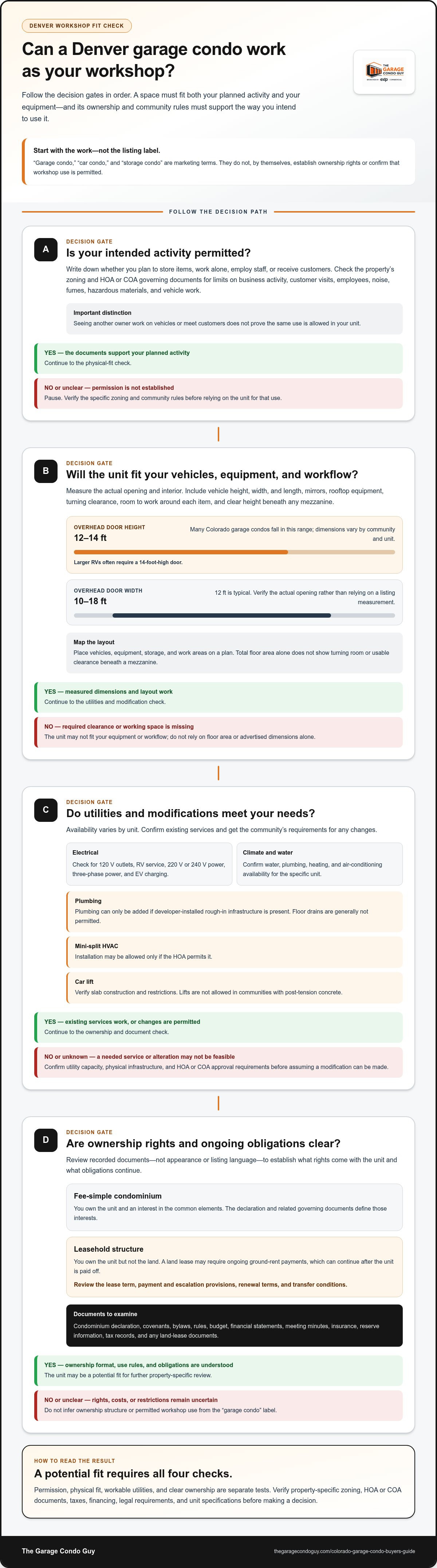
Start by defining the work. A space suited to hobby projects or storage may not allow a customer-facing business. Zoning and HOA or COA rules determine permitted activities. Seeing another owner work on vehicles or meet customers does not prove the same use is allowed in your unit. Before evaluating listings for workshop space for sale denver, write down whether you plan to store items, work alone, employ staff, or receive customers.
Match the unit to your equipment and workflow
Measure more than floor area. Check the height, width, and length of vehicles and equipment, including mirrors and rooftop equipment. Also consider door dimensions, turning clearance, interior dimensions, and the room needed to work around each item. Many Colorado garage condos have overhead doors in the 12-to-14-foot height range, but dimensions vary by community and unit. Larger RVs often require a 14-foot-high door. Door widths commonly range from 10 to 18 feet, with 12 feet typical. Verify the actual opening before you rely on a listing measurement.
If there’s a mezzanine, measure the actual clear height beneath it. Ceiling height alone doesn’t establish how much usable clearance remains. Map where vehicles, equipment, storage, and work areas will sit so you can assess the layout, not just the unit’s total area.
Check the electrical service and other utilities against your needs. Units may have 120 V outlets, RV service, 220 V or 240 V power, three-phase power, EV charging, water, plumbing, heating, or air-conditioning. Availability varies, and changes may require HOA or COA approval. Plumbing can only be added if developer-installed rough-in infrastructure is present. Floor drains are generally not permitted. Mini-split HVAC may be installed only if the HOA allows it. If you’re considering a car lift, verify the slab construction and restrictions: lifts are not allowed in communities with post-tension concrete.
Verify workshop permissions before relying on a use
Review zoning and governing documents for limits on business activity, customer visits, employees, noise, fumes, hazardous materials, and vehicle work. These rules determine whether the unit works for your operation. The phrase Denver garage condo workshop rules points to a key distinction: physical fit and permitted use are separate tests. The National Association of Realtors commercial real estate resources offer broader context, but property-specific zoning and community documents control the decision. For a structured overview of the buying process, consult the Colorado garage condo buyer’s guide.
Denver Workshop Property Due Diligence: Documents, Condition, and Carrying Costs
Before making an offer on workshop space for sale denver, assemble a property-specific due-diligence file. Review the condominium declaration, covenants, bylaws, rules, budget, financial statements, meeting minutes, insurance, reserve information, tax records, and any land-lease documents. Inspect the roof and structure, concrete slab, doors and opener, electrical system, heating and A/C, plumbing, fire sprinklers, drainage, windows, and mezzanine.
Review governing documents and ownership terms
Check permitted-use limits, rental rules, alteration requirements, assessment procedures, and which insurance obligations belong to the association or unit owner. Compare those terms with your planned use and any modifications you may need. For leasehold ownership, read the ground-rent provisions, lease term, escalation and renewal terms, and transfer conditions. These details affect ongoing costs and may matter to a future buyer.
Read budgets, financial statements, meeting minutes, and reserve information together. They can help you identify planned work, recurring expenses, and discussion of special assessments. Dues alone won’t show the full cost of ownership.
Assess financing and property condition
Possible purchase methods include commercial real-estate loans, local bank or credit-union financing, SBA financing for qualifying owner-occupied business uses, seller financing, or cash. Pre-qualification can help clarify a lender’s requirements, but approval depends on the buyer, lender, and specific project.
During inspection, focus on the roof and structure, slab, overhead door and opener, electrical system, heating and A/C, plumbing, fire sprinklers, drainage, windows and doors, and mezzanine and stairs. Check actual clear height below a mezzanine. If the unit has upgrades, verify that they were approved and permitted. For your carrying-cost estimate, include property taxes, HOA or COA dues, insurance, electricity, heat, internet, water, routine maintenance, possible special assessments, and land-lease payments if applicable. Use property-specific records because costs and obligations vary by unit and community.
For a structured purchase and due-diligence overview, use the Colorado garage condo buyer’s guide. Verify zoning, governing documents, taxes, financing, legal requirements, condition, and costs for the specific property before purchase.
How to Find and Buy Workshop Space for Sale in Denver
A consistent process helps you compare workshop space for sale denver without letting a listing headline drive the decision. Start with the work you plan to do, then assess each property against your operating needs, ownership terms, and budget.
Define the use. Set out whether the space is for storage, hobby work, or business operations, including whether your plan depends on employees or customer visits.
Shortlist locations. Compare regular and peak-hour drive times, highway access, security, access hours, and community amenities.
Compare units. Match dimensions, doors, utilities, layout, and carrying costs to your vehicles, equipment, and workflow.
Review documents. Examine ownership terms, permitted uses, community rules, and ongoing obligations.
Inspect the property. Assess its condition and confirm the unit’s practical fit before moving forward.
Negotiate and complete due diligence. Use your findings to shape an offer and resolve property-specific questions before closing.
Choose a location around your actual operating needs
Think beyond distance on a map. A unit near home may be convenient for occasional projects, while a business workshop may need efficient highway access and suitable access hours. Compare Denver and nearby Front Range communities, including Boulder, Longmont, Lakewood, Superior, Dacono, Golden, Centennial, Aurora, Castle Rock, Broomfield, Englewood, Highlands Ranch, Littleton, and Commerce City. Weigh the actual route, peak-hour drive time, and amenities at each development. Explore Denver garage condo properties as one location-specific starting point.
Move from evaluation to a purchase decision
A garage-condo specialist can locate relevant properties, compare pricing and features, negotiate, and guide buyer due diligence. Cash closings may take 10-14 days; financed closings may take 30-60 days, depending on the lender and transaction. Use the Colorado garage condo buyer’s guide to organize your next steps. Timing and suitability vary by property, so verify the unit’s zoning, governing documents, taxes, financing, legal requirements, and specifications before purchase.
Set Your Workshop Purchase Up for a Clear Decision
Before moving forward, decide what would make a property a clear yes, a no, or worth negotiating over. Set priorities for location, usability, community rules, and ownership structure. Compare each candidate against the same priorities so a single attractive feature, such as extra space or a convenient route, doesn’t distract from the overall fit.
For workshop space for sale denver, write a short decision brief: what the space must support, where you’re willing to compromise, and what would make you walk away. Use it to compare options and weigh tradeoffs during negotiations.
The Garage Condo Guy provides buyer representation for garage condos across Colorado, including help locating and evaluating properties, negotiating, and navigating due diligence. To discuss your search, call or email The Garage Condo Guy.
Frequently Asked Questions
Can I operate a business from a Denver garage condo?
It depends on the property, zoning, community rules, and the specific operation. List the work you plan to do, equipment and materials involved, deliveries, and any planned expansion. Then check each activity against the governing documents and zoning requirements. A low-impact hobby workspace and a business operation may be subject to different restrictions.
Can customers or employees visit my garage-condo workshop?
Customer and employee visits inside garage-condo units are generally prohibited. Don’t build your operating plan around regular visitors. Check the property’s actual rules for any specific access questions, including vendors and deliveries, rather than assuming each type of visit is treated the same. A unit may still suit storage or work that doesn’t depend on visitors.
Can I add plumbing to a garage condo workshop?
Plumbing can only be added if developer-installed rough-in infrastructure is present and the required approvals permit the work. Confirm that the rough-in is inside the unit and identify its location before planning a sink or work area. Plumbing in a shared amenity is not the same as rough-in plumbing in your unit. Floor drains are generally not permitted.
Are garage condos taxed as residential property?
Garage condos are generally taxed as commercial real estate. To estimate this cost, review the tax record and bill for the specific unit and applicable year. Include the verified amount in your ownership budget rather than relying on a residential estimate or figures from another development.
How long does it take to buy a garage condo in Colorado?
Cash closings may take 10-14 days, while financed closings may take 30-60 days, depending on the lender and transaction. Plan around lender documents, appraisal and underwriting, title work, association records, inspection findings, and closing documents. The timing is an estimate, not a promised date.



Comments