Garage Condo vs. Home Garage: Denver Comparison Guide
Can your standard three-car garage actually handle door heights between 12-14 ft or a twin-post lift without hitting the ceiling? Most Denver homeowners realize too late that residential zoning and HOA rules weren't designed for serious collectors or specialized business needs. You're likely feeling the squeeze of limited ceiling heights and the lack of industrial power. When deciding on Garage Condo vs. Home Garage: Which Denver Option is Best?, the choice involves more than just floor space. It's a trade-off between residential convenience and industrial-grade utility that home garages cannot legally or physically match.
This guide provides a data-driven comparison of space, utilities, and ownership structures to help Front Range owners decide between residential and specialized storage. We'll break down everything from the $28,916 average cost of a Denver detached garage to the 29% commercial tax assessment rate applied to the 1,950 specialized units across Colorado. General educational information only. Verify property-specific zoning, HOA/COA documents, taxes, financing and legal requirements before purchase.
Table of Contents
The Functional Gap: Dimensions and Clearances in Denver Storage
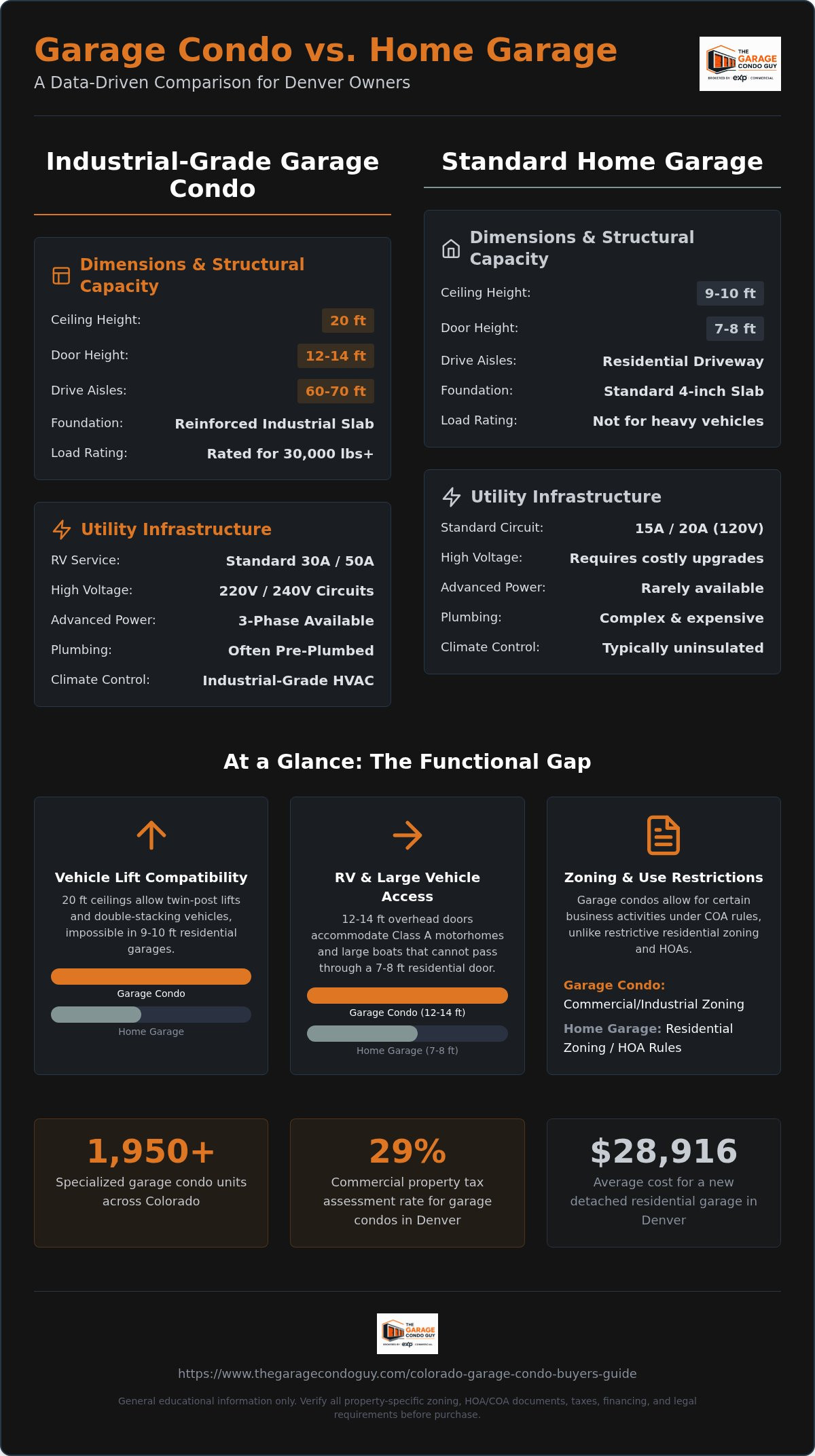
Analysis of 12 actual Colorado projects reveals a significant divide between residential standards and industrial requirements. Most homes follow a standard Residential Garage Overview with 4-inch concrete slabs. These foundations aren't rated for the 30,000-pound weight of a Class A motorhome. Specialized units utilize reinforced industrial slabs to prevent cracking under heavy loads. You'll find that these floors are engineered to handle the point loads of heavy lifts and larger vehicles without structural failure.
Physical protection is vital given the Front Range hail frequency. Enclosed steel-framed units offer durability that standard carports or detached residential structures lack. When evaluating Garage Condo vs. Home Garage: Which Denver Option is Best?, structural integrity is a primary differentiator. These buildings provide 20 ft of vertical space. This height allows for 10-11 ft of clear height under mezzanines, creating two levels of functional area without compromising vehicle clearance below.
Vertical Storage and Vehicle Lifts
Installing a twin-post lift requires more than floor space. You need specific clear height, not just raw ceiling height. Most Denver home garages stop at 9 or 10 feet. This makes double-stacking vehicles impossible without expensive structural modifications to the roof trusses. Specialized units provide the 20 ft vertical clearance needed to operate lifts safely while maintaining usable space on a mezzanine above. It's an efficient way to double your storage capacity within a single footprint.
Door Dimensions for RVs and Boats
Entry points are often the biggest bottleneck for collectors. Colorado garage condos typically feature door heights in the 12-14 ft range. These openings accommodate high-profile fifth wheels and large center-console boats that won't fit through a residential header. Specialized communities in areas like Dacono or Longmont also provide wider drive aisles. These 60-70 ft aisles allow for easier backing and maneuvering than a tight suburban driveway. Review the Colorado Garage Condo Buyer's Guide for specific site plans and turning radii.
Utility Infrastructure: Beyond the Standard 120V Home Outlet
Most residential garages rely on a single 15-amp or 20-amp circuit. This setup barely supports a shop vac and a battery tender simultaneously. If you're asking Garage Condo vs. , power capacity is a deciding factor. Specialized units come standard with 30A or 50A RV service. They also feature 220V/240V circuits designed for industrial welders and heavy-duty air compressors. Homeowners often face thousands in electrical panel upgrades just to charge an EV and run a heater without tripping breakers.
Plumbing adds another layer of complexity. Adding a bathroom or floor drain in a residential setting often triggers strict Denver zoning reviews and expensive sewer tap fees. In a specialized facility, these features are frequently pre-plumbed. HOA or COA approval remains a non-negotiable step before any installation. Industrial-grade flexibility means running equipment that would simply overwhelm a standard residential electrical service.
Specialized Electrical Service
Small business owners and serious hobbyists often require 3-phase power. This is rarely available in residential neighborhoods. When evaluating projects in areas like Commerce City, you must verify the total ampacity of the unit's sub-panel. This ensures your specific machinery won't exceed the building's load limits. It's a critical step in your due diligence process.
Climate Protection and Denver Weather
Denver's 40-degree temperature swings accelerate wear on leather interiors and rubber seals. Specialized units utilize industrial-grade HVAC systems and high R-value insulated overhead doors to maintain a stable environment. This climate control is vital for protecting Garage Resale Value over time. You can find detailed utility specs and infrastructure requirements in our Colorado Garage Condo Buyer's Guide to help plan your specific build-out.
Zoning and Use Restrictions: What You Can Actually Do
Ownership structure is the first legal hurdle in the Garage Condo vs. debate. In Colorado, most units are fee-simple condominiums where you own the title to the interior space. However, some developments operate on leasehold or land-lease structures. You must review the specific declarations and bylaws for each project. Don't assume that because another owner runs a business or makes noise, you have a legal defense for doing the same. HOA and COA documents are the final word on permissible activity.
One absolute rule exists across the Front Range: these units are not residential. Zoning laws strictly prohibit overnight stays and permanent habitation. For a deeper dive into these limitations, read about Can You Live in a Garage Condo? Front Range Regulations. General educational information only. Verify property-specific zoning, HOA/COA documents, taxes, financing and legal requirements before purchase.
Business vs. Personal Use
Zoning determines if your unit is a simple storage space or a personal warehouse for business inventory. Many Front Range communities restrict customer traffic and the number of employees allowed on-site. If you plan to use the space for more than hobbyist work, you must verify the commercial use-case with the local municipality. Reviewing the last two years of board meeting minutes can reveal if the community is currently cracking down on specific business activities or signage violations.
Customization and Permitting
Adding a mezzanine or plumbing isn't as simple as hiring a contractor. You operate within a COA framework that requires architectural approval before construction begins. Verifying that previous owners pulled permits for existing stairs or mezzanines is a critical inspection item. Unpermitted work can lead to fines or forced removal during a resale. If you're ready to evaluate a specific property, consult the Colorado Garage Condo Buyer's Guide to understand the due diligence requirements for customized units.
Strategic Comparison: Resale, Carrying Costs, and Representation
Financial overhead is the final pivot point in deciding Garage Condo vs. . Denver residential property is taxed at a 6.7% to 7.05% assessment rate, but garage condos fall under the 29% commercial rate. You must also factor in monthly HOA dues, which have increased 20-25% since 2022 due to rising insurance costs. While a home garage addition costs an average of $28,916 in Denver, the industrial utility of a condo often justifies the higher carrying costs for high-value assets.
Financing these units differs from residential lending. Most buyers utilize commercial real estate loans, though SBA financing is available for qualifying owner-occupied business uses. Navigating these niche requirements is why a Front Range garage condo specialist is necessary for any transaction. They understand the specific valuation drivers that residential appraisers often overlook.
Long-Term Value Factors
Our methodology involved evaluating 12 examples of resale trends across the Front Range. Data shows that units with 14 ft door heights and robust community reserve funds command a premium. Always review the COA’s financial health and reserve studies before closing. Poorly managed associations can lead to special assessments that erode your equity. Location within the development also matters; units with direct pull-through access typically see faster resale times than those in tight corners.
Final Decision Framework
Use this checklist to determine your best path for 2026:
Does your vehicle height require a 12-14 ft door?
Will your equipment trip a standard 20-amp residential breaker?
Does your residential HOA prohibit your specific business inventory?
Can you justify the 29% commercial tax rate for the added security?
Is a 20 ft ceiling height required for double-stacking vehicles?
Get the full breakdown of every variable in the Colorado Garage Condo Buyers Guide. General educational information only. Verify property-specific zoning, HOA/COA documents, taxes, financing and legal requirements before purchase.
Choosing Your Future Storage Strategy in Denver
Deciding between a home upgrade and a specialized unit depends on your specific physical and legal requirements. Standard residential garages often fall short on door heights and electrical capacity. Specialized developments offer 12-14 ft door ranges and 3-phase power options. These features solve problems that home modifications simply can't touch. When asking Garage Condo vs. , you're balancing residential convenience against industrial-grade utility. It's a choice between a simple parking spot and a professional-grade asset.
Expert representation is vital for navigating the niche industrial storage market across the Front Range. We provide a specialized focus and data-driven analysis to ensure your purchase aligns with your long-term goals. General educational information only. Verify property-specific zoning, HOA/COA documents, taxes, financing and legal requirements before purchase.
Download the Colorado Garage Condo Buyers Guide for a complete due diligence checklist. We're ready to help you secure a space that fits your lifestyle and your collection perfectly.
Frequently Asked Questions
Can I run a small business out of a Denver garage condo?
Yes, many developments allow small business activity, but you must verify the specific zoning and COA documents first. Some Front Range communities restrict customer traffic, employee counts, and signage. While these units are often marketed as personal warehouses, they aren't zoned for high-traffic retail or heavy industrial manufacturing. General educational information only. Verify property-specific zoning, HOA/COA documents, taxes, financing and legal requirements before purchase.
What is the typical clear height under a mezzanine in a Colorado car condo?
In a building with 20-foot ceilings, you typically find 10-11 feet of clear height under a mezzanine. This measurement is critical for owners of high-profile RVs or those planning to install vehicle lifts. When considering Garage Condo vs. , remember that residential ceilings rarely offer this vertical flexibility. Always confirm the actual usable clearance for your specific unit before closing on a property.
Are there restrictions on working on my own cars in a garage condo?
Restrictions on automotive work vary significantly across the Front Range. While some communities welcome hobbyists, others explicitly prohibit major mechanical work or the storage of hazardous materials in the bylaws. Never rely on what other owners appear to be doing; you must review the actual HOA/COA declarations and meeting minutes. General educational information only. Verify property-specific zoning, HOA/COA documents, taxes, financing and legal requirements before purchase.
How do property taxes for garage condos compare to residential property in Colorado?
Garage condos are taxed at the Colorado commercial assessment rate, which is currently 29% of the market value. This is significantly higher than the residential assessment rate of approximately 6.7% to 7.05% applied to home garages. This tax difference is a major factor in the Garage Condo vs. financial comparison. Always verify the specific mill levy for your unit's location.
Can I install a car lift in a standard 20-foot ceiling unit?
Yes, most 20-foot ceiling units are designed to accommodate vehicle lifts, but you must obtain COA approval first. You'll need to verify the concrete slab thickness and ensure the lift's posts don't interfere with fire sprinklers or mezzanine supports. Unlike standard home garages, these industrial-grade spaces provide the vertical clearance required for double-stacking vehicles safely. Verify all structural specifications and permitting requirements during your due diligence period.


Comments