Garage Condo Market Trends Colorado: 2026 Industry Analysis
Updated: Aug 16
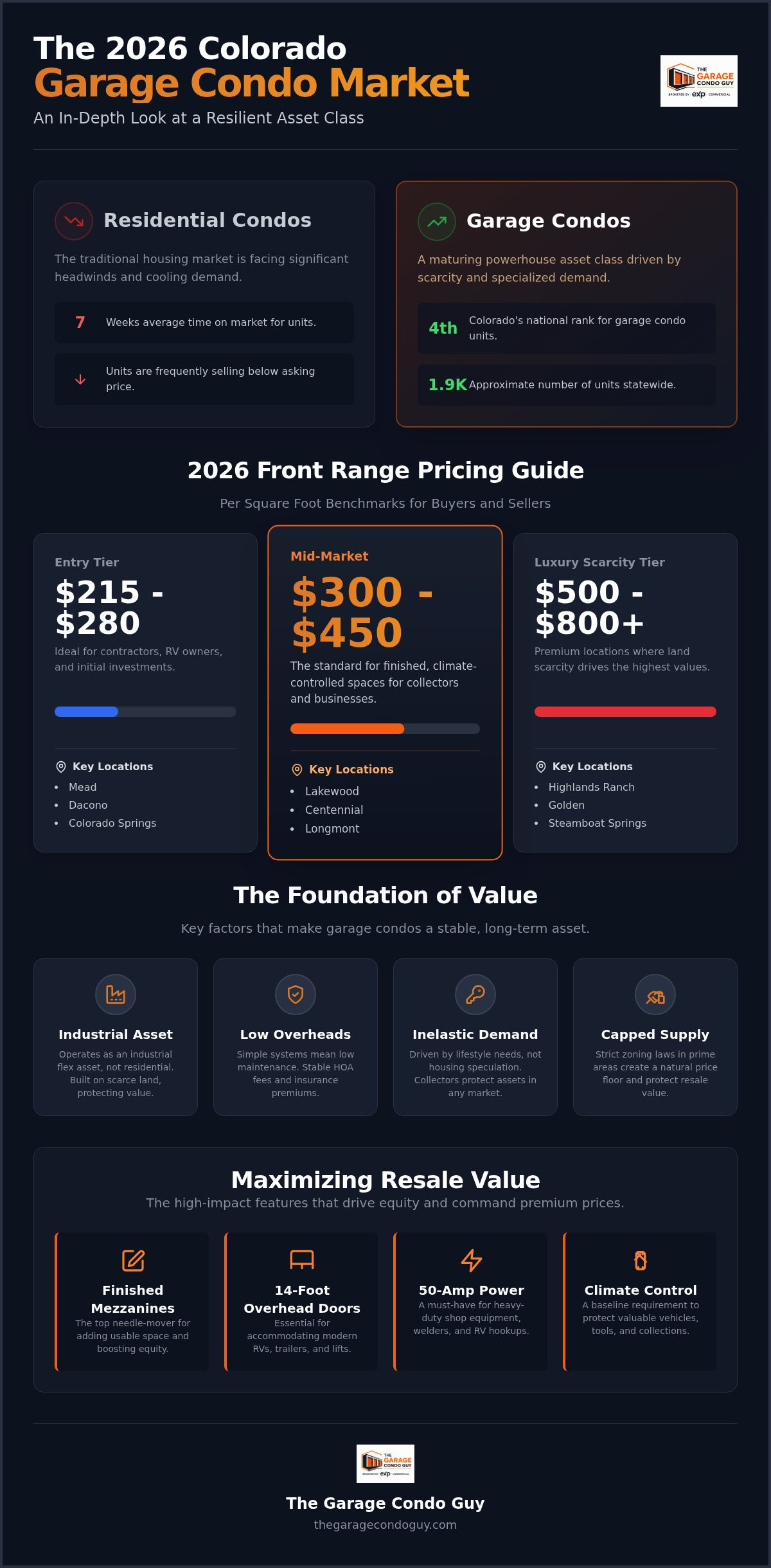
The Denver residential condo market is hitting a wall with units sitting for seven weeks and selling below asking, but don't let those headlines scare you away from high-end storage. The garage condo market trends Colorado is experiencing in 2026 tell a completely different story of resilience. While traditional housing softens, the demand for specialized flex-use spaces is maturing into its own powerhouse asset class. Colorado now ranks fourth nationally with nearly 1,950 units, proving this isn't just a niche hobby anymore.
It's easy to feel frustrated by rising insurance costs and the shrinking inventory in prime Front Range locations. You want to know if you're overpaying when Steamboat Springs units command $828 per square foot while Mead averages closer to $300. This analysis provides the clarity you need. We'll break down the 2026 pricing tiers, explain how new CCIOA regulations impact your bottom line, and give you a framework to evaluate a garage condo as a serious long-term asset. It's time to stop guessing and start looking at the data that actually matters for your collection.
Table of Contents
Colorado Garage Condos vs. Residential: The 2026 Decoupling
Residential multifamily units are feeling the heat right now. High-rise owners face ballooning insurance premiums and litigation-heavy environments that drag down resale value. Garage condos are different. They utilize a condominium ownership structure, but they operate as industrial flex assets. This distinction is the core of the garage condo market trends colorado is seeing in 2026. While residential buyers might be distressed by market cooling, garage condo buyers are driven by lifestyle needs and the scarcity of high-quality storage. You aren't looking for a place to sleep; you're looking for a fortress for your assets.
Industrial land across the Front Range is vanishing. Cities like Lakewood and Golden have strict zoning laws that limit new supply. This scarcity creates a natural floor for prices. You aren't just buying a box; you're buying a piece of a shrinking industrial footprint. When supply is capped by local government, your resale value stays protected even if the housing market takes a breather. It's a fundamental shift that rewards specialized owners.
Why Industrial Real Estate Rules Apply Here
Maintenance is the biggest differentiator. Residential condos have complex plumbing, HVAC systems, and shared living amenities that break. Garage condos are simple. They require minimal upkeep, which keeps your long-term costs predictable. Even during economic shifts, car storage demand remains inelastic. Collectors don't sell their prize assets just because the housing market fluctuates; they protect them. This creates a stable environment where utility outweighs speculation.
The HOA and Insurance Factor
Residential HOAs are often battlegrounds for litigation. Garage condo communities avoid this because they don't house people. This leads to lower, more stable fees. Insurance providers view these as low-risk industrial storage, not high-liability residential zones. It's a key reason why garage condo market trends colorado investors track remain positive. In 2026, the typical insurance profile for a Colorado garage condo focuses on property coverage and general liability, avoiding the massive premiums seen in high-density housing.
Front Range Pricing Tiers: Benchmarks for Buyers and Sellers
Navigating the garage condo market trends colorado offers requires a clear map of the current pricing landscape. It isn't a one-size-fits-all market. In 2026, we see three distinct tiers across the Front Range that define the entry point and potential upside for owners. The entry-level tier, featuring cities like Mead, Dacono, and Colorado Springs, currently sits between $215 and $280 per square foot. Mid-market standards in Lakewood, Centennial, and Longmont range from $300 to $450 per square foot. If you're looking at Highlands Ranch, Golden, or Steamboat Springs, prepare for the luxury scarcity tier where prices soar from $500 to over $800 per square foot.
These benchmarks fluctuate based on the level of finish. A raw shell in Mead won't command the same interest as a fully climate-controlled unit in Centennial. Buyers are becoming more sophisticated, looking past the base price to evaluate the total utility of the space. It's about finding the right balance between location and amenities.
Market Clusters: Where the Activity is Peaking
Location dictates utility. The Mead and Longmont corridor has become a massive hub for contractors and RV owners who need high-clearance space without the luxury price tag. Down south, the Centennial and Highlands Ranch area acts as the epicenter for high-end car condos, catering to collectors who want social amenities alongside their storage. Boulder and Superior remain high-barrier micro-markets due to extreme land scarcity. Interestingly, the Colorado Springs Industrial Market Summary confirms that smaller-bay units continue to outperform the broader market, a trend we see mirrored in the garage condo space as demand for flexible, sub-2,000-square-foot units remains high.
Resale Value Drivers
What makes one unit worth significantly more than the one next door? It often comes down to the internal build-out. While climate control is a baseline requirement, finished mezzanines are the real needle-movers for equity. You can see how these additions directly impact garage condo resale value when units hit the secondary market. Buyers also pay a premium for 14-foot overhead doors and 50-amp power. These aren't just perks; they are essential for modern RVs and heavy-duty shop equipment. If you're trying to determine which pricing tier fits your investment goals, you can get a direct market evaluation here.
The 2026 Demand Shift: From Storage to Flex-Use Hubs
The way owners utilize their units is changing fast. We're seeing a massive shift from passive storage to high-activity hubs. This evolution is a primary driver of the garage condo market trends colorado is experiencing today. It isn't just about parking a car anymore. It's about creating a "Personal Warehouse" that serves as a command center for your life and business. Whether you're an entrepreneur or a collector, these spaces now function as extensions of your home or office.
RV owners are also driving this demand shift. Residential HOAs across the Front Range are tightening the screws on driveway parking, making a dedicated condo the only permanent solution. You get 24/7 access, 50-amp power, and a climate-controlled environment that preserves your investment better than any outdoor lot. It's a strategic move to protect a six-figure asset from the Colorado elements while staying compliant with local regulations.
Small Business Flex Solutions
Many Denver entrepreneurs are ditching traditional industrial leases. Why pay a landlord when you can build equity? These units are becoming legitimate operational bases for inventory, light assembly, and professional services. Owning your space provides significant tax advantages like depreciation and mortgage interest deductions that renting simply can't match. It’s a smart move for any small business looking to stabilize long-term costs in a maturing market.
Luxury Automotive Storage Trends
For the car community, the "social" garage is the new standard. Collectors want more than just four walls. They want clubhouse environments with detailing bays, high-end security, and a community of like-minded enthusiasts. The Denver garage market is rapidly evolving to meet these luxury needs. We're seeing more amenitized developments that feel like private clubs rather than simple storage facilities. Ready to find a space that fits your lifestyle? Contact us to explore current flex-use availability across the Front Range.
Strategic Outlook: Navigating a Maturing Asset Class
By 2026, the wild west era of high-end storage has ended. We've entered the phase of institutionalization. This means more predictable pricing, higher construction standards, and a clearer set of benchmarks for owners. These garage condo market trends colorado investors track now reflect a professionalized asset class. For buyers, the goal is to look beyond the base price per square foot. You must evaluate "Utility ROI." Does the unit offer the 50-amp power required for a workshop? Is the site plan wide enough for a 45-foot RV? These functional details drive long-term value far more than the initial sticker price.
Sellers face a different challenge. With seven new developments currently in the construction and planning pipeline, timing your exit is critical. You don't want to list your unit just as a developer finishes a massive new phase nearby. Understanding the local micro-market is the only way to protect your equity. This is why specialized garage condo buyer representation is non-negotiable. You need an advocate who knows the pipeline before the projects even break ground.
Future Inventory Pipeline
The Northern Front Range continues to see the most aggressive growth, while the South Metro remains supply-constrained. Interest rate stabilization throughout late 2025 and 2026 has brought transaction volume back to healthy, sustainable levels. This stability allows for better financial planning. You can now forecast carrying costs with more confidence than we saw during the volatile period following the pandemic.
Expert Guidance for the Next Move
Generalist residential agents often struggle with this asset class. They don't understand industrial zoning, three-phase power, or the specific nuances of garage condo appraisals. You need a specialist who lives in this niche. Whether you're looking to buy your first unit or plan a strategic exit from your current space, you can contact The Garage Condo Guy for a localized market valuation. Don't leave your investment to a generalist when you can have a dedicated advocate who knows the Front Range inside and out.
Future-Proof Your Front Range Portfolio
The landscape has shifted. Garage condos are no longer just a luxury; they're a strategic industrial asset that decouples your portfolio from the volatility of residential real estate. By understanding the current garage condo market trends colorado is driving, you can move beyond simple storage and start building real equity in a space that works as hard as you do. Whether you're scaling a business or protecting a world-class collection, the right unit provides a permanent solution in a market defined by land scarcity and maturing demand.
Don't leave your next move to a generalist agent who doesn't know a mezzanine from a detailing bay. You need the specialized authority of a broker who lives in this niche. Backed by the industrial expertise of Loop Commercial Real Estate, we bring a deep understanding of local zoning and the specific lifestyle demands that residential agents miss. It's time to get the insider data you need to make a confident, asset-focused decision.
Get a Specialized Market Analysis from The Garage Condo Guy today. Let's find the space that fits your vision and secures your assets for the long haul.
Common Questions About Colorado Garage Condos
Is the garage condo market in Colorado in a bubble for 2026?
No, the market isn't in a bubble; it's entering a phase of sustained maturity. Demand for specialized storage still outpaces the limited inventory in prime Front Range locations. While residential sectors show signs of cooling, the garage condo market trends colorado tracks remain strong because these units are industrial assets. Land scarcity in cities like Golden and Lakewood ensures that supply cannot easily meet the needs of the growing collector and small business community.
Why are garage condo prices so much higher per square foot than traditional industrial space?
Pricing is higher because you're buying a finished, sub-divided asset rather than a raw industrial shell. Traditional industrial warehouses are often sold as massive, 20,000-square-foot blocks. Garage condos offer high-value features like climate control, 14-foot overhead doors, and mezzanine finishes in a much smaller footprint. You're paying for the specialized utility and the ability to own a small-bay unit, which is currently the highest-performing segment of the industrial market.
Do garage condos in the Front Range appreciate as fast as residential homes?
Garage condos are currently outperforming residential appreciation in many Colorado micro-markets. Denver's residential condo market has seen prices stagnate and selling times stretch to nearly seven weeks. In contrast, the scarcity of industrial-zoned land keeps garage condo values resilient. Owners benefit from an asset class that isn't tied to the same interest rate sensitivities or buyer distress found in the housing sector.
What are the typical HOA fees for a car condo in Denver or Boulder?
Fees are generally lower and more stable than residential alternatives because these sites don't have the high-liability risks of housing. Colorado's CCIOA regulations cap interest on unpaid assessments at 8% and limit fines for non-safety violations. This legal framework ensures your carrying costs remain predictable. Most owners find these costs are manageable because the associations don't have to maintain complex residential amenities or high-occupancy plumbing systems.
Can I run a retail business out of my Colorado garage condo?
Most garage condos are zoned for industrial flex-use, which typically prohibits traditional walk-in retail operations. However, they are perfect for inventory storage, light assembly, and e-commerce fulfillment. You should always verify specific municipal codes in cities like Denver or Boulder before signing. These spaces are designed as operational bases for entrepreneurs rather than storefronts meant for heavy foot traffic or public shopping.


Comments