Front Range Storage Cost Calculator Tool | Garage Condos
Updated: Aug 16
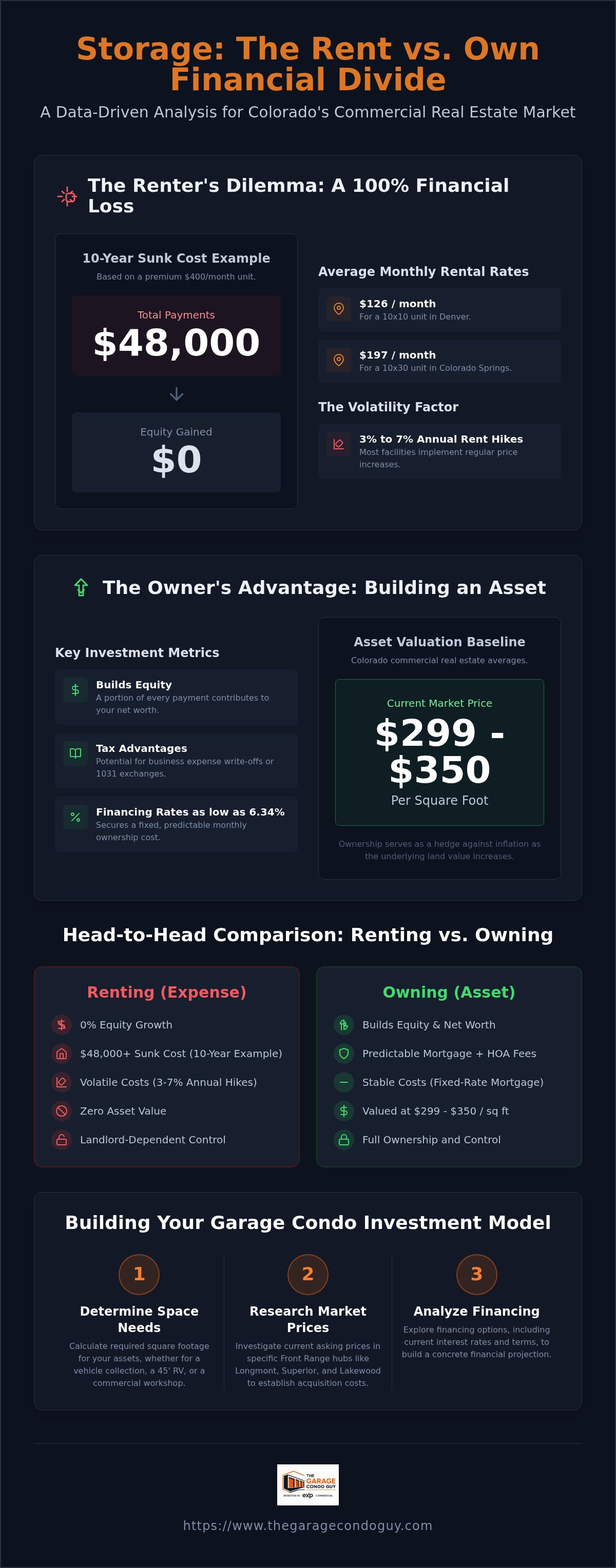
Your monthly storage bill is a 100% loss that never builds equity. In Denver, renting a 10x10 unit costs an average of $126 per month, while a 10x30 unit in Colorado Springs averages $197. Over a decade, these recurring payments transform into thousands of dollars in sunk costs without providing climate control or high-level security for your assets. Using a Storage Cost Calculator Tool helps you identify the exact point where renting stops making financial sense.
It's frustrating to watch rental rates climb while your vehicles or equipment sit in a facility you don't own. This guide provides a clear framework to evaluate the financial difference between traditional leasing and owning a deeded garage condo. You'll learn how to calculate the true return on investment by looking at Colorado commercial real estate averages, which currently range from $299 to $350 per square foot. We'll break down current interest rates, which can be as low as 6.34%, and examine how property appreciation changes your long term outlook.
Table of Contents
Why You Need a Physical Storage Cost Calculator Tool
A Storage Cost Calculator Tool provides a financial framework to compare monthly rental fees against the long term costs of real estate ownership. For a standard overview of the self-storage industry, most facilities operate on a lease model where tenants have no claim to the underlying property. In Denver, a 10x10 unit averages $126 per month. If you require a larger 10x30 space in Colorado Springs, the average cost is $197. While these numbers seem manageable monthly, they represent a total loss of capital.
Paying $400 per month for a premium unit creates a 10 year trap. Over a decade, you spend $48,000. You own nothing at the end of that period. Beyond the base rent, you must factor in insurance premiums and the necessity of climate control. Colorado's volatile weather makes temperature management a non-negotiable expense for protecting vehicle engines, electronics, and upholstery. A proper calculation must include these recurring protection costs to show the true price of leasing.
The Sunk Cost of Traditional Renting
Rent isn't static. Most facilities implement annual hikes between 3% and 7%. A $400 unit today could cost significantly more in five years. Over 20 years, a tenant might spend over $100,000 on a standard 12x30 unit without gaining a cent in equity. Using a data-driven model helps visualize these compounding losses. When you add the 3.8% annual decrease in some local rental rates, the volatility of the market makes long term planning difficult for renters.
Lifestyle Costs: The Value of Your Time
Accessibility often gets ignored in basic math. Driving to a remote facility in the Front Range takes time and fuel. If you value your time at a professional rate, a 45 minute round trip twice a week adds up to thousands of dollars in lost productivity annually. A deeded space in a central location like Longmont or Lakewood provides a convenience premium that rental units cannot match. For a detailed breakdown of your specific situation, you can contact our advisory team.
The Rent vs. Buy Equation: Calculating Your Real Storage ROI
A Storage Cost Calculator Tool reveals that the primary difference between renting and owning is the equity advantage. When you rent, your capital disappears. When you own a deeded garage condo, a portion of every payment contributes to your net worth. Current self-storage growth trends indicate a consistent demand for space, but investors who own the asset capture the value of that demand. In Colorado, commercial real estate prices average between $319 and $350 per square foot, providing a baseline for asset valuation.
Ownership also unlocks tax strategies that aren't available to renters. As a commercial property, a garage condo may qualify for business expense write-offs or 1031 exchanges, allowing you to defer capital gains taxes when moving between investments. You must account for HOA fees and maintenance costs, which cover shared security and structural upkeep. These expenses are predictable and often lower than the cumulative cost of annual rent hikes at traditional facilities.
Appreciation vs. Inflation
Owning a condo serves as a hedge against inflation. While storage rental rates in Denver recently saw a 3.8% decrease, historical trends show that property values in the Front Range remain resilient. You lock in your costs today while the underlying land value increases. This makes car storage investment opportunities particularly attractive in markets like Boulder where industrial land is scarce.
The Business Flex Space Factor
Small business owners often use a Storage Cost Calculator Tool to justify transitioning from traditional industrial leases to ownership. A garage condo provides a professional base for operations without the risk of a landlord terminating the lease. If you're ready to analyze a specific property, you can request a professional valuation to see how the numbers align with your goals.
Step-by-Step: Building Your Garage Condo Investment Model
To move beyond simple rent comparisons, you must populate your Storage Cost Calculator Tool with local market data. This process transforms a vague idea into a concrete financial projection. Start by determining your required square footage. A collection of five vehicles requires different clearance than a 45 foot RV or a commercial workshop. Once your footprint is defined, research current asking prices in specific Front Range hubs like Longmont, Superior, or Lakewood to establish your acquisition cost.
The next step involves analyzing financing. Commercial loan rates in Colorado currently range from 5.55% to 8.93%. Whether you choose a cash purchase or a loan with a specific loan-to-value ratio, these numbers dictate your monthly carry. Finally, subtract your projected tax savings and appreciation from the total. With Colorado commercial real estate showing a median cap rate of 6%, the growth of the asset often offsets the cost of ownership over time. Viewing self-storage as an investment provides a helpful macro perspective on why these assets remain in high demand.
Customization and Value-Add
Strategic upgrades directly impact your resale value. Adding a structural mezzanine or professional grade epoxy flooring increases the functional utility of the space. These custom improvements transform a standard storage unit into a personalized man cave asset that commands a higher price point in the secondary market.
Expert Guidance in the Front Range
Accurate modeling requires more than just average numbers. A Front Range garage condo specialist provides access to off-market data and specific complex documents that impact your bottom line. If you need help verifying the numbers for a specific facility, you can schedule a professional model review to ensure your data is accurate.
Front Range Storage Solutions: Turning Expenses into Equity
The Denver and Boulder markets face a unique challenge: the extreme scarcity of industrial-zoned land. This supply constraint directly impacts future storage costs across the Front Range. As municipal zoning becomes more restrictive, the cost of developing new facilities rises. This creates a baseline for property values that rental units cannot leverage. A Storage Cost Calculator Tool applied to this region often shows that ownership is a protection against these rising market pressures and land shortages.
The final verdict for most long term storage needs is clear. When you compare a 15 year rental horizon against a deeded asset, the "calculator test" favors ownership. While rent represents a pure expense, a garage condo functions as a real estate asset with a median cap rate of 6.66% in Denver. You secure your space and your costs simultaneously. This stability is particularly valuable as commercial property marketing periods in Northern Colorado have shortened from 185 days in 2024 to 132 days in 2025, indicating a faster-moving market.
Ready to Stop Renting?
Ryan at The Garage Condo Guy provides specialized buyer representation to help you identify units in emerging hubs. Prices in areas like Superior and Dacono are currently influenced by high demand and limited industrial footprints. Acting while inventory is available in these specific corridors is essential for long term value. Expert guidance ensures you navigate complex condo documents and understand the specific utility of each facility.
Get Your Custom Calculation
Generic tools provide averages, but your specific asset collection requires a professional market analysis. A personalized model accounts for your specific square footage, desired amenities, and local tax implications. You can contact The Garage Condo Guy for a personalized storage ROI consultation to verify your numbers before making a commitment.
Take Control of Your Storage Investment
Evaluating your long term financial outlook requires moving past monthly rental receipts. Using a Storage Cost Calculator Tool highlights the disparity between sinking capital into a leased unit and building equity in a deeded asset. We've examined how Front Range land scarcity and commercial appreciation trends favor ownership for high-value assets. Transitioning to a garage condo provides a stable, climate-controlled environment for your collection while securing a footprint in a competitive real estate market.
Expert guidance is essential when navigating complex condo documents and local market fluctuations. Ryan specializes exclusively in Colorado garage condos and brings the specialized authority of Loop Commercial Real Estate to every transaction. Whether you're analyzing a car collection footprint or a business flex space, professional modeling ensures your data is accurate. You don't have to guess about your return on investment anymore. Start Your Storage ROI Calculation—Contact Ryan Today to explore available inventory and secure your future in the Front Range.
Frequently Asked Questions
Is a garage condo a better investment than traditional self-storage?
Ownership is generally superior because it converts a recurring expense into a deeded real estate asset. While traditional storage costs average $1.32 per square foot in Colorado Springs for small units, that capital is unrecoverable. Ownership allows for principal paydown and long term appreciation. With a median cap rate of 6% for Colorado commercial real estate, the property generates equity that traditional rental models simply cannot provide.
How do I calculate the monthly cost of owning a garage condo?
You should use a Storage Cost Calculator Tool to aggregate your mortgage payment, HOA dues, property taxes, and insurance premiums. Start with current commercial loan rates, which recently fell between 5.55% and 8.93% in Colorado. Add the monthly HOA fee, which typically covers facility security and exterior maintenance. Subtract potential tax deductions or business write-offs to find your net monthly carry compared to a standard rental unit.
What are the hidden fees when buying a car condo in Colorado?
Beyond the purchase price, you must account for closing costs like title insurance, recording fees, and loan origination charges. You should also factor in the initial HOA capital contribution often required at the time of closing. Property taxes for commercial assets in the Front Range and specific utility costs for climate control or high-voltage power upgrades should be included in your financial model to avoid budget surprises.
Can I use a garage condo for my small business to save on rent?
Many entrepreneurs utilize these units as flex space for inventory storage, light assembly, or professional workshops. This transition stabilizes your occupancy costs by replacing variable lease rates with a fixed mortgage. Since the property is a deeded commercial asset, it provides long term stability that traditional industrial leases lack. Always verify that your specific business activity complies with local zoning and the facility's specific association covenants.
What is the typical resale value of a garage condo in the Denver area?
Resale value depends on the specific sub-market and unit upgrades. In Denver, the average asking price for commercial real estate is $299 per square foot. Units with high-value improvements like structural mezzanines or professional flooring often command a premium. The scarcity of industrial-zoned land in the Front Range supports steady valuation, as evidenced by the shortening of marketing periods for commercial properties to 132 days in 2025.


Comments