Finding Garage Condos Near Denver: Top Front Range Spots
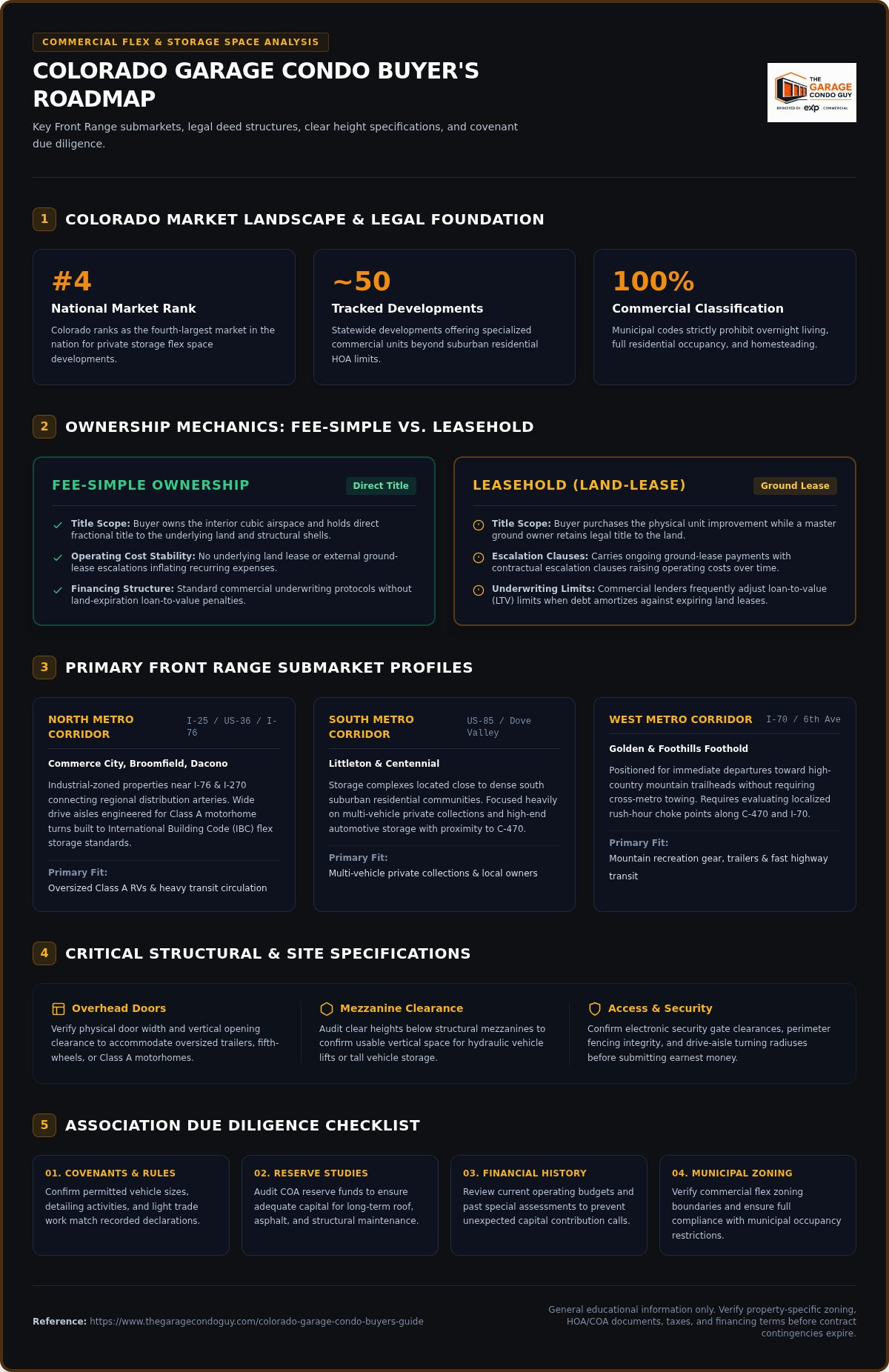
Colorado ranks as the fourth-largest market in the nation for private storage flex space, with roughly 50 tracked developments statewide. If you are actively evaluating garage condos near Denver, securing space is rarely as simple as browsing standard commercial real estate listings.
You probably already feel the squeeze from suburban residential HOAs that prohibit trailers, RVs, and vehicle collections in driveways. Moving beyond residential restrictions makes sense, but distinguishing between fee-simple deeds and land-lease arrangements quickly complicates the buying process. You also can't afford to overlook structural realities like unusable mezzanine clearances or inadequate overhead door heights.
This guide gives you an objective roadmap for evaluating regional submarkets, ownership structures, and association covenants across the Front Range. We will analyze prime corridors along I-25, US-36, and I-70, identify critical door and ceiling specifications, and outline the exact due diligence checks needed to protect your purchase.
Table of Contents
Understanding Garage Condo Ownership Structures Near Denver
Marketing terms like "car condo," "toy barn," and "personal warehouse" sound casual, but they represent a formal legal framework. At its foundation, a garage condo functions under a standard condominium ownership structure applied to commercial real estate. Buyers own the interior cubic airspace of their individual unit, alongside an undivided shared interest in the facility's common elements. Critically, these are strictly commercial properties. Local municipal codes and zoning ordinances strictly prohibit overnight living, full residential occupancy, and homesteading.
Fee-Simple vs. Leasehold Legal Differences
Property deeds define what you actually own. When reviewing garage condos near Denver, watch for whether the deed conveys fee-simple ownership or a leasehold estate:
Fee-Simple: You own the unit airspace and hold direct fractional title to the underlying land and structural shells.
Leasehold (Land-Lease): You purchase the physical unit improvement, but a master ground owner retains legal title to the land, leasing it back to the association.
Leasehold units carry ongoing ground-lease payments with built-in escalation clauses. Over time, those escalating fees raise operating expenses. They also trigger rigorous underwriting requirements from commercial lenders, who often adjust loan-to-value limits when amortizing debt against expiring land agreements.
Governing Documents and HOA Due Diligence
Purchasing garage condos near Denver requires deep due diligence before releasing contract contingencies. Request the condominium association (COA) declarations, bylaws, and specific house rules. You must confirm that your planned vehicle sizes, detailing activities, or light trade work match the recorded covenants. Audit the association reserve studies, current operating budgets, and histories of special assessments to protect yourself from surprise capital contributions. For structured verification workflows, review the Colorado Garage Condo Buyers Guide before submitting earnest money.
General educational information only. Verify property-specific zoning, HOA/COA documents, taxes, financing and legal requirements before purchase.
Primary Front Range Submarkets for Denver Garage Condos
Location dictates daily utility. Evaluating garage condos near Denver requires balancing direct highway access against site-specific municipal zoning. Proximity to transit corridors like I-25, E-470, US-36, and I-70 determines how quickly you can hitch up a trailer, reach mountain trailheads, or access freight distributors. Each regional hub caters to distinct storage profiles and vehicle dimensions.
North Metro Corridors: Commerce City, Broomfield, and Dacono
Northern submarkets provide spacious site circulation for oversized equipment:
Commerce City: Centered near I-76 and I-270, industrial-zoned properties offer direct transit routes connecting regional commercial distribution arteries with central Denver.
Broomfield and Dacono: Developments positioned along the US-36 and northern I-25 corridors provide wide drive aisles engineered for heavy Class A motorhome turns. These properties align with industrial construction standards established by the International Building Code for non-residential flex storage.
South and West Metro Corridors: Littleton, Centennial, and Golden
Centennial and Littleton host prominent south metro storage complexes, especially near the Dove Valley area and along the US-85 corridor. These facilities sit close to dense residential communities, serving owners managing multi-vehicle private collections. West along I-70 and Sixth Avenue, communities around Golden allow rapid departures toward high-country trails without requiring cross-metro hauling. Before purchasing, verify gate clearance dimensions, perimeter security fencing, and localized rush-hour choke points along C-470.
To evaluate available inventory across these submarkets, explore our curated Denver garage condos inventory guide, or consult the comprehensive Colorado garage condo buyers guide to review site-selection criteria.
General educational information only. Verify property-specific zoning, HOA/COA documents, taxes, financing and legal requirements before purchase.
Critical Specifications: Clear Heights, Doors, and Utilities
A unit's listed square footage tells only half the story. When touring garage condos near Denver, vertical dimensions and utility infrastructure dictate whether your planned layout actually works. Misjudging overhead tracks or joist heights can turn a prized commercial space into an unusable box.
Door Dimensions and Usable Vertical Clearance
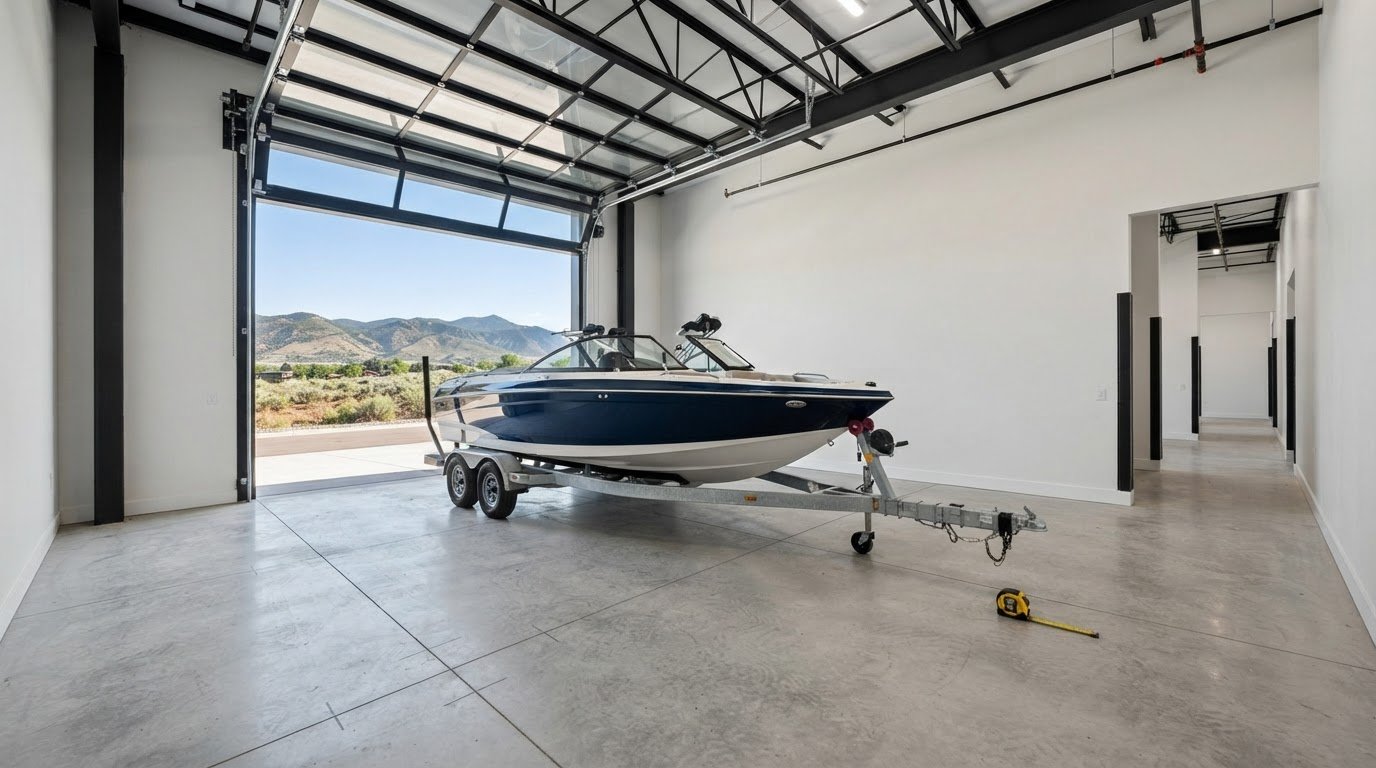
Standard roll-up doors in Front Range complexes typically measure between 12 and 14 feet in height. Class A motorhomes, stacker trailers, and tall recreational rigs generally require a full 14-foot overhead clearance. Don't stop at the door opening. You must measure the interior clear height from finished concrete slab to the lowest structural purlin or hanging mechanical line.
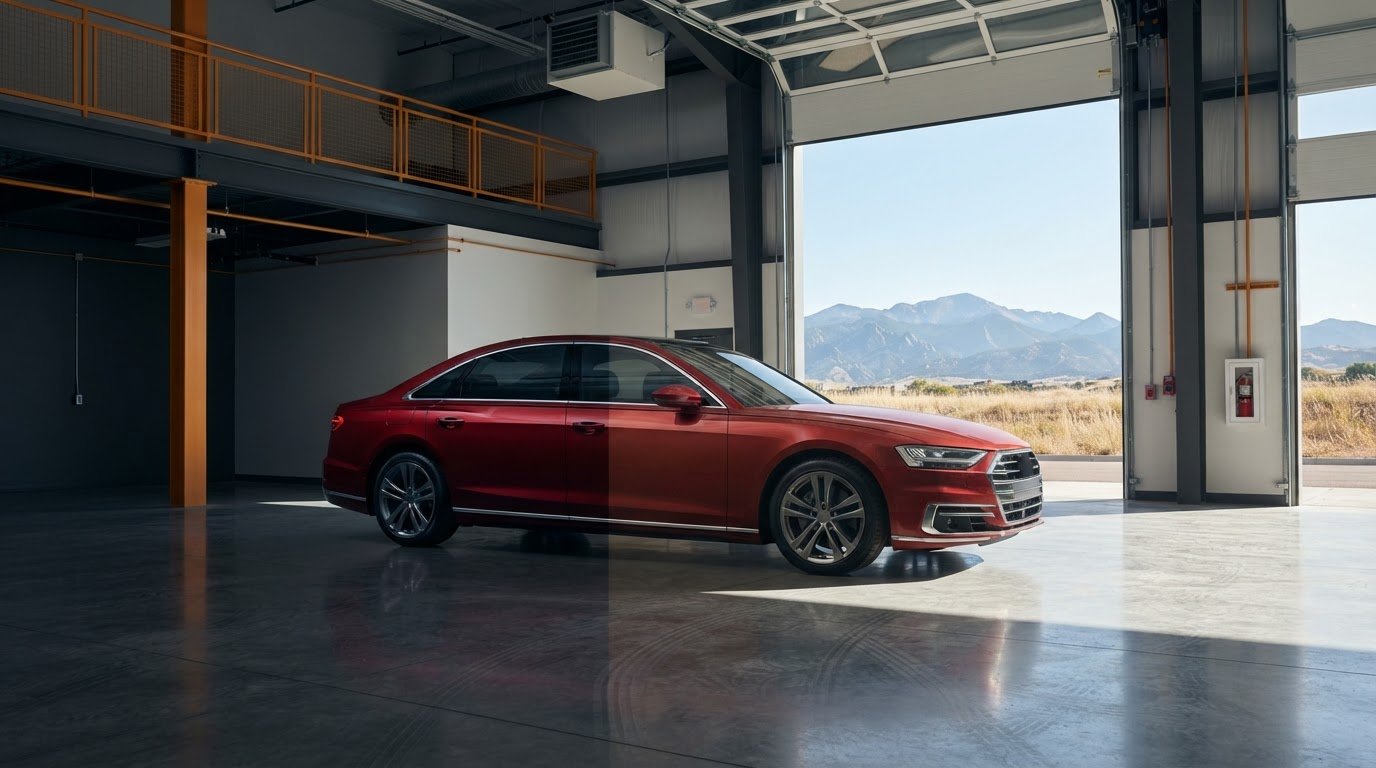
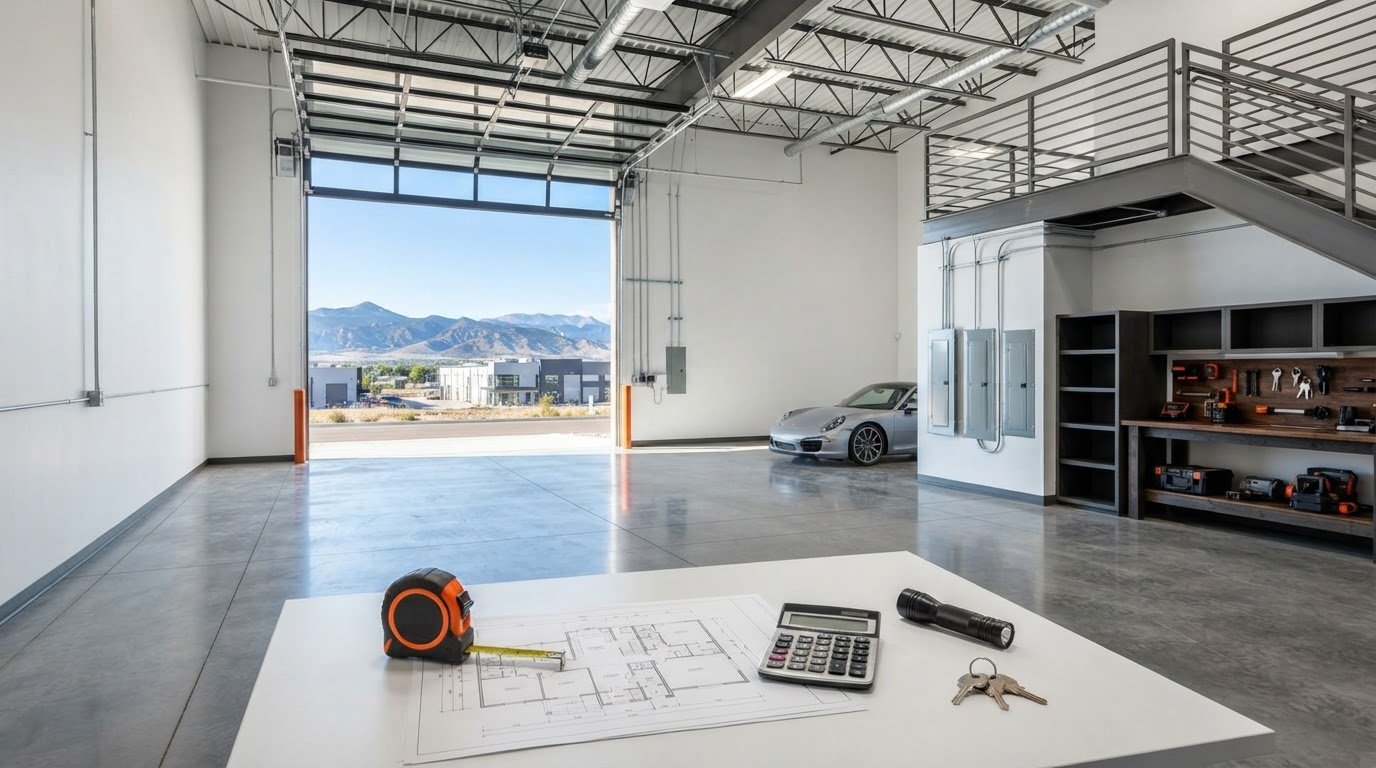
Mezzanines complicate vertical planning. A structural mezzanine creates secondary office or storage floor area above, but it dramatically reduces clearance below. Often, you are left with only 10 to 11 feet of usable clear height beneath the deck framing. That lower clearance immediately restricts where you can install a two-post or four-post vehicle lift. Check the exterior asphalt approach apron too; steep transition angles can easily scrape low-profile splitters and extended trailer undercarriages.
Electrical, Plumbing, and Climate Control Capacity
Utility service levels vary considerably across individual complexes:
Electrical Service: Verify whether the unit subpanel delivers 100-amp or 200-amp capacity, and confirm dedicated 30A or 50A RV outlets alongside 240V hookups for heavy welders or compressors.
Water and Sewer: Never assume you can add a private restroom or utility sink. Confirm existing rough-in stub-outs and association wastewater allocations before making offers.
HVAC: Inspect installed gas-fired unit heaters and verify ceiling insulation R-values to ensure stable winter temperatures.
Download our Colorado garage condo inspection checklist to cross-examine structural clear heights and electrical panels before writing a purchase contract.
General educational information only. Verify property-specific zoning, HOA/COA documents, taxes, financing and legal requirements before purchase.
Due Diligence Checklist: Covenants, Permitted Uses, and Closing
Executing structured due diligence prevents costly operational surprises when purchasing garage condos near Denver. Because these assets are commercial condominiums, standard residential inspection routines and consumer contracts don't apply. Buyers must follow a systematic evaluation process before closing.
Verifying Operational Rules and Prohibited Activities
Your first step is auditing the condominium association declarations, bylaws, and house rules:
Commercial Operations: Check whether the COA restricts customer visitation, employee parking, daily delivery freight, or on-site welding and spray painting.
Vehicle and Storage Limits: Determine whether the association strictly prohibits outdoor trailer parking, and verify specific thresholds for flammable liquid or chemical storage.
Permitted Modifications: Confirm rules for anchoring two-post vehicle lifts into the concrete slab, routing pneumatic lines, or framing secondary mezzanines.
Securing experienced garage condo buyer representation helps identify restrictive operational rules buried deep inside association declarations.
Physical Inspections and Specialty Financing Steps
Step two requires hiring an experienced commercial building inspector. The inspection must evaluate slab load capacities, test overhead roll-up door springs, and confirm proper fire sprinkler deflector distances beneath ceiling structures.
Steps three and four resolve tax modeling and debt structure. For the 2026 tax year, Colorado assesses most commercial properties at 25% or 26% of actual value, making local mill levy verification critical to calculating ongoing carrying costs. Because conventional residential mortgages cannot fund non-residential assets, buyers rely on commercial portfolio loans or SBA 504 financing for owner-occupied business uses. Fixed SBA 504 rates averaged roughly 6.53% for 20-year terms and 6.54% for 25-year terms in September 2026.
General educational information only. Verify property-specific zoning, HOA/COA documents, taxes, financing and legal requirements before purchase.
Next Steps for Securing Your Front Range Space
Finding the right garage condos near Denver requires verifying ownership mechanics, physical clearances, and association covenants upfront. Confirming fee-simple title over ground-lease arrangements protects your equity. Simultaneously, field-checking overhead door heights and under-mezzanine clearances ensures your vehicles, lifts, and gear fit so you don't face surprises after closing.
A disciplined due diligence strategy prevents operational friction. Dedicated buyer representation provides specialized Front Range commercial advisory, guiding you through association declarations, reserve fund audits, municipal zoning classifications, and ground-lease risks.
Take control of your site selection across the I-25, US-36, and I-70 corridors. Partnering with a dedicated specialist ensures you uncover hidden property restrictions before earnest money goes hard. Review Colorado garage condo listings and buyer representation options to navigate your commercial property purchase with complete confidence.
General educational information only. Verify property-specific zoning, HOA/COA documents, taxes, financing and legal requirements before purchase.
Frequently Asked Questions
Can you legally live inside a garage condo near Denver?
No, you can't legally live inside garage condos near Denver. These properties are classified as commercial or industrial condominiums rather than residential dwellings. Municipal building codes, fire regulations, and local zoning ordinances strictly prohibit overnight living, sleeping quarters, and residential occupancy. Condominium association declarations reinforce these municipal restrictions with strict fines, facility access revocation, and legal enforcement for any unauthorized overnight or domestic residential use.
What are the typical door heights and clear heights in Front Range units?
Overhead doors across Front Range developments typically range between 12 and 14 feet in height. Class A motorhomes and enclosed stacker trailers generally require a full 14-foot door opening. While total interior ceiling heights often reach 18 to 22 feet, don't overlook interior obstructions. Installing a mezzanine cuts clearance substantially, frequently leaving only 10 to 11 feet of usable clear height beneath the framing, restricting vehicle lift placements.
What is the difference between fee-simple and leasehold garage condos?
Fee-simple ownership grants you complete real estate title to your specific unit alongside an undivided percentage interest in the facility's common elements. In a leasehold or land-lease arrangement, you purchase only the physical building improvement while an outside party retains the underlying ground. Leasehold properties require recurring land rent payments, carry scheduled escalation clauses, and create stricter loan underwriting requirements when securing commercial financing from banks or local credit unions.
Can I run an active business out of a Denver garage condo?
Business use depends entirely on local municipal zoning and the specific community declarations recorded by the condominium association. Many garage condos near Denver allow trade work, light assembly, e-commerce storage, and back-office operations. However, associations frequently restrict or prohibit heavy customer foot traffic, outside vehicle parking, excessive noise, and hazardous chemical usage. You should always audit the association's permitted use clauses before committing earnest money to any commercial contract.
Are water, sewer, and high-voltage power universally available in every unit?
No, utility services aren't universally available across every complex or individual space. While many developments provide basic 120V electrical circuits and shared clubhouse restrooms, individual unit plumbing requires dedicated wet-utility stubs and association architectural approval. High-voltage 240V lines, 30A or 50A RV receptacles, 3-phase power, and dedicated climate control systems vary by site plan and require written board authorization before any physical installation begins.
General educational information only. Verify property-specific zoning, HOA/COA documents, taxes, financing and legal requirements before purchase.
Comments