Climate Controlled RV Storage: Colorado Buyer's Guide
Buying indoor storage is a technical commercial real estate transaction, not just an equipment upgrade. If you are evaluating climate controlled RV storage for sale along the Front Range, you already know the stakes. Colorado's high-altitude UV radiation, severe hailstorms, and rapid 50-degree temperature swings can degrade seals, paint, and tires on a six-figure coach within a few short seasons.
Yet finding a facility that accommodates your rig involves far more than measuring bumper-to-bumper length. You need clear facts on vertical clearance, active climate standards, and legal property titles. This guide delivers an objective breakdown of Front Range unit specifications, winter heating baselines, and the structural differences between fee-simple and leasehold ownership. You will learn the exact due diligence steps required to protect your investment and secure long-term cost stability. General educational information only. Verify property-specific zoning, HOA/COA documents, taxes, financing and legal requirements before purchase.
Table of Contents
What is Climate Controlled RV Storage Ownership?
When searching for climate controlled RV storage for sale, buyers encounter a distinct commercial real estate asset class known as the garage condo or personal warehouse. Unlike standard rental lockers found at traditional climate-controlled storage facilities, purchasing an RV condo grants a deeded real estate interest. You own the specific interior footprint rather than leasing temporary space under escalating triple-net (NNN) agreements.
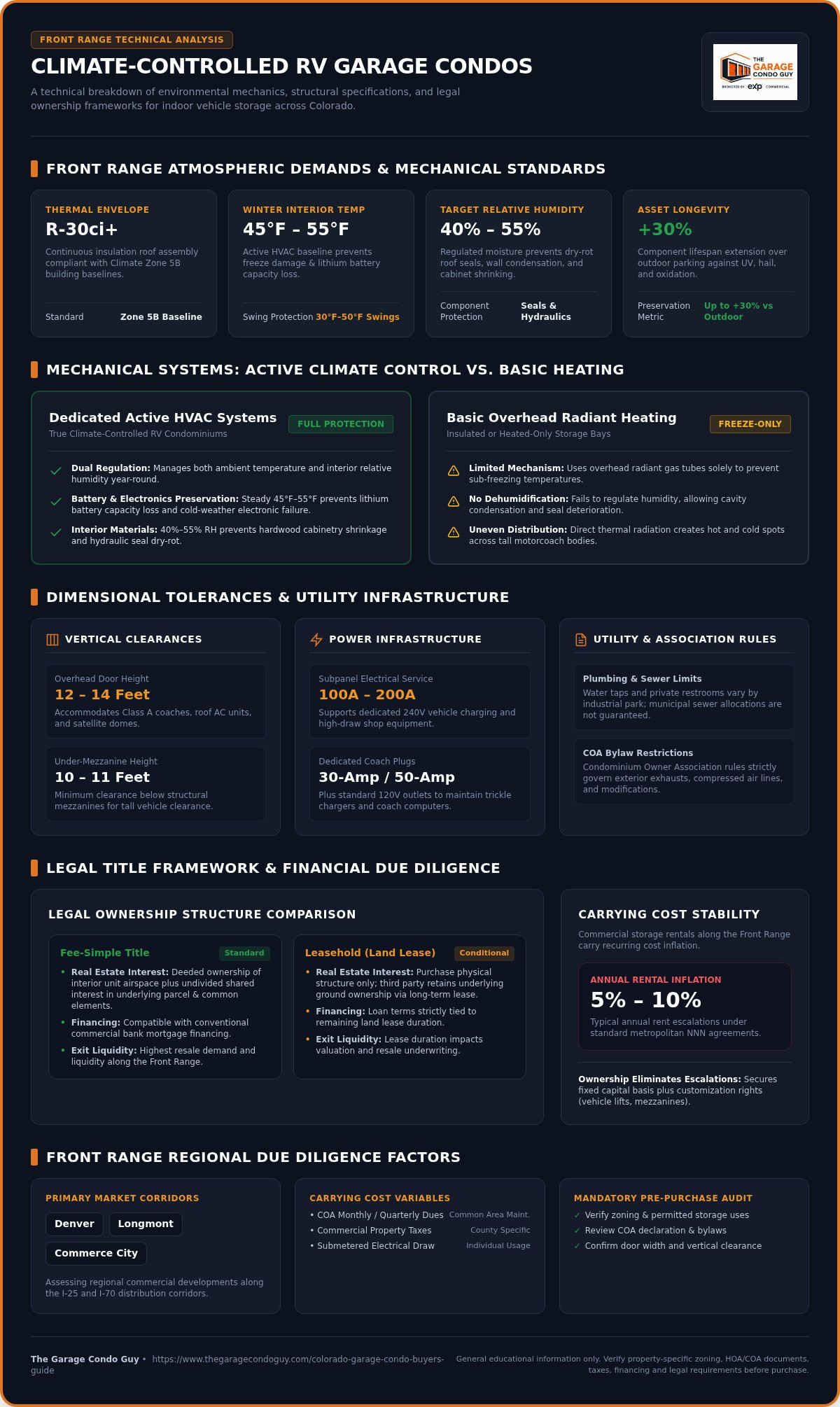
True climate-controlled units provide dedicated HVAC systems designed to regulate both temperature and interior humidity year-round. In contrast, basic insulated or heated bays merely run overhead radiant gas tubes to prevent sub-freezing conditions. Understanding this mechanical difference ensures your high-value coach receives active environmental protection.
Ownership Structures: Fee-Simple vs. Land Lease
Not all storage condominiums carry identical property rights. Buyers encounter two primary legal titles along the Front Range:
Fee-Simple Ownership: You hold outright deeded ownership to the interior unit airspace along with an undivided shared interest in the common elements and underlying parcel. This structure offers the strongest resale liquidity and aligns best with standard commercial bank financing.
Leasehold (Land Lease): You purchase the physical structure, but a third party retains ownership of the ground beneath it via a long-term lease. Financing terms are strictly tied to the remaining lease duration, which can complicate exit pricing.
Why Colorado Buyers Choose Ownership Over Renting
Ownership eliminates the 5% to 10% annual rent escalations typical in metropolitan storage facilities. A purchased bay provides long-term cost stability and complete interior customization. Owners routinely install 50-amp dedicated coach charging, vehicle lifts, or structural mezzanines. For a detailed breakdown of local utility allowances and market financing, review our Colorado garage condo buyer's guide before making an offer.
The Mechanics of Climate Control in the Front Range
Colorado's Front Range subjects vehicles to severe environmental stress. High-altitude UV exposure, destructive summer hail, and rapid 30-to-50-degree temperature swings accelerate body panel oxidation and dry-rot roof seals. Searching for climate controlled RV storage for sale means securing an envelope that actively buffers against these atmospheric shifts. Standard commercial builds comply with Climate Zone 5B baselines, aligning with principles detailed in the Colorado State University Extension insulation guidelines to maintain continuous thermal boundaries with roof assemblies reaching R-30ci or higher.
Protecting Against Colorado Temperature Swings
Active HVAC systems maintain winter interior temperatures between 45°F and 55°F while managing relative humidity between 40% and 55%. This controlled environment extends coach component lifespan by up to 30% compared to outdoor parking. Regulated humidity prevents interior hardwood cabinetry from shrinking, stops condensation within wall cavities, and preserves delicate hydraulic lines. Maintaining steady warmth also prevents lithium house batteries and coach electronics from suffering cold-weather capacity loss.
Standard Utility Offerings in Colorado RV Condos
Utility infrastructure determines practical functionality. A standard bay includes dedicated 120-volt outlets and a 30-amp or 50-amp RV hookup to run trickle chargers and onboard management computers without draining house banks.
Power Capacity: Most modern developments feature 100-amp to 200-amp individual subpanels, supporting 240V vehicle charging or heavy workshop tools.
Plumbing Restrictions: Never assume water hookups or private restrooms are permitted. Municipal water taps and community sewer allocations vary widely by industrial park.
Association Approvals: COA bylaws strictly govern modifications such as exterior compressor exhausts, compressed air piping, or high-draw equipment.
To verify which Front Range developments support private utility rough-ins and high-draw electrical services, explore the Colorado garage condo buyer's guide.
Evaluating RV Storage for Sale: Technical Specifications
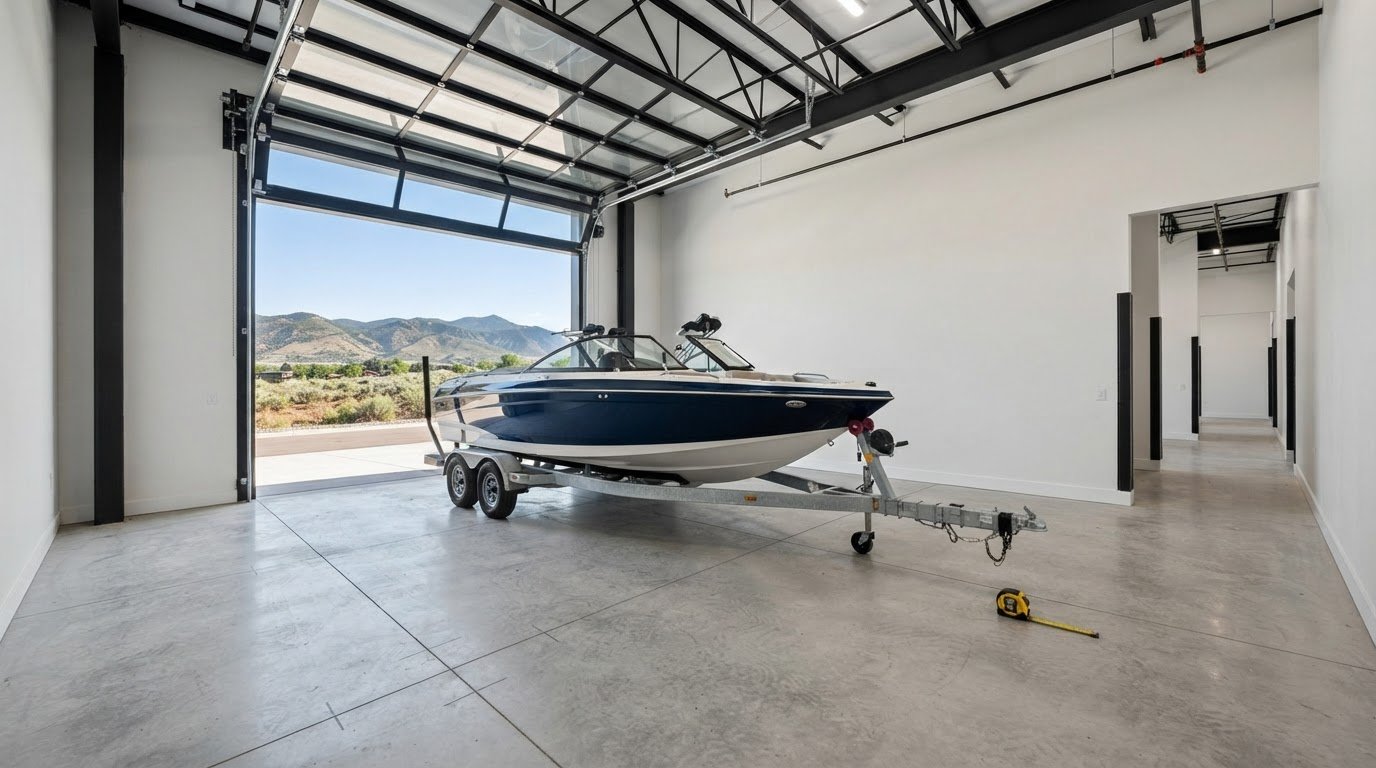
Selecting climate controlled RV storage for sale requires precise dimension checks before writing a purchase contract. Overhead door heights across Front Range facilities typically measure between 12 and 14 feet. A modern Class A motorhome or fifth wheel often sits at 13 feet 6 inches with roof-mounted air conditioners and satellite domes installed. Even minor grade changes on approach ramps can cause a tall rig to clip the header if overhead clearance is inadequate.
Drive aisle geometry is equally vital. Maneuvering a 40-foot coach requires drive aisles measuring 50 to 65 feet wide. Tight turning radiuses between building rows can turn basic parking into a structural hazard.
The Mezzanine Factor: Added Value vs. Clearance Risks
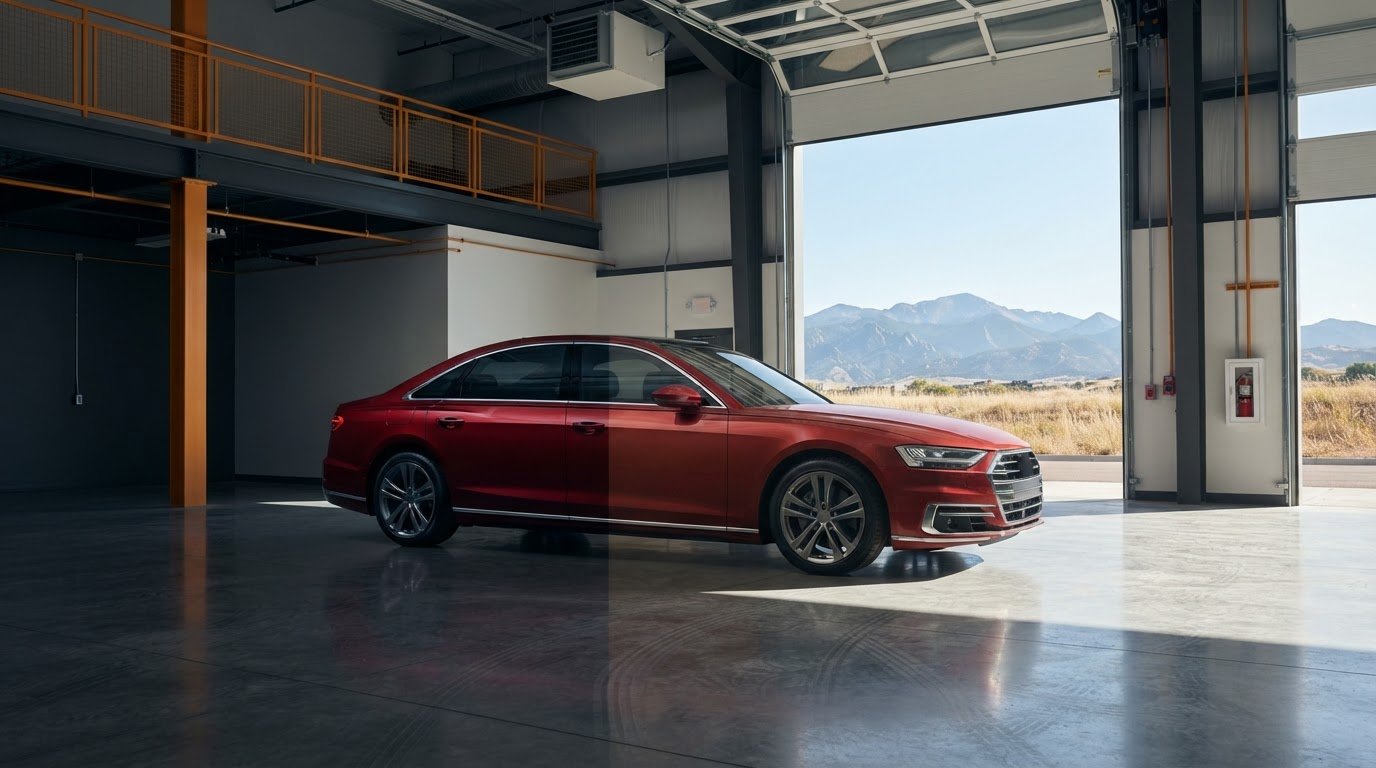
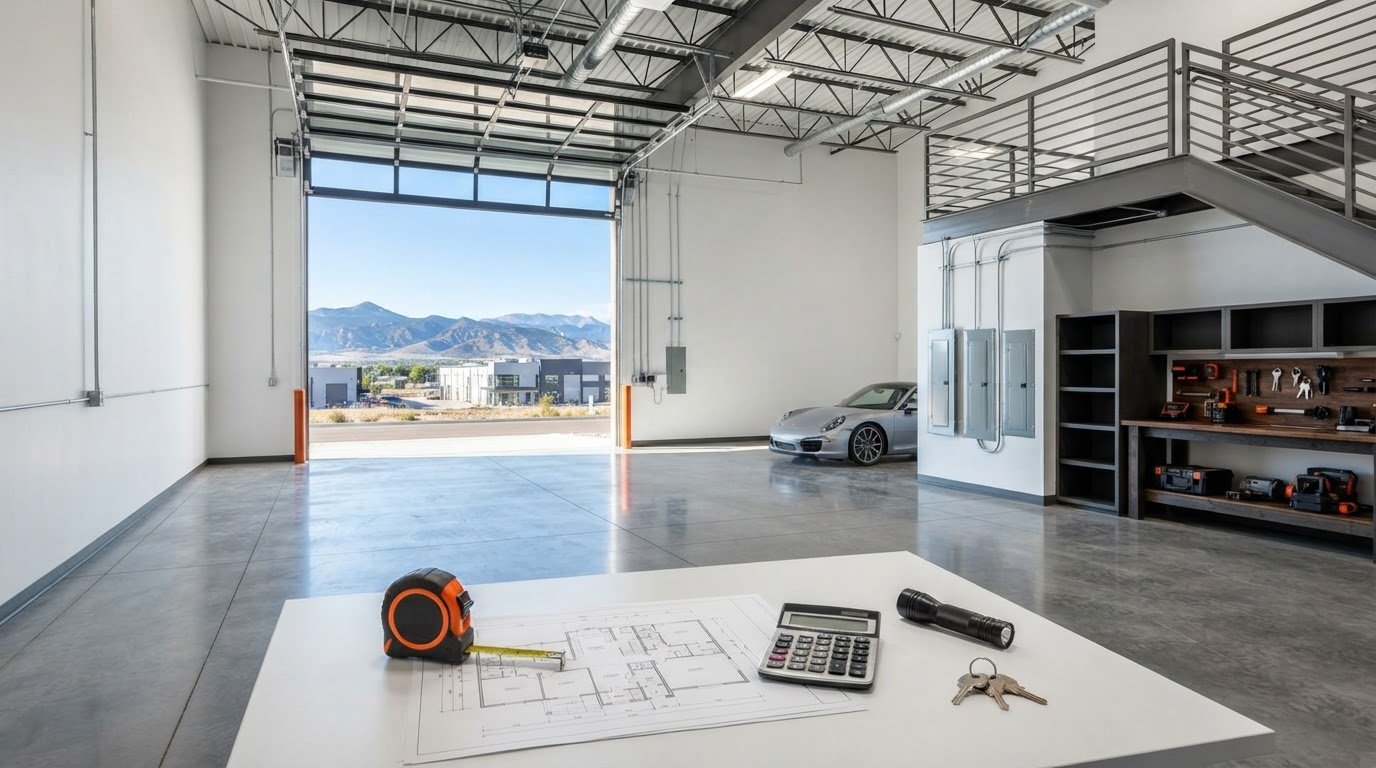
Mezzanines add valuable square footage for lounge furniture or desk setups, but they consume critical vertical volume. In buildings with 20-foot ceilings, installing a mezzanine commonly reduces usable clearance below the platform to just 10 to 11 feet. This clearance safely fits standard pickup trucks or boats, but it completely blocks full-height RV parking beneath the structure. Retaining structural permits and aligning with ENERGY STAR air sealing and insulation standards is essential when adding suspended decks to ensure conditioned air circulates evenly.
Due Diligence Checklist for RV Unit Buyers
Technical due diligence goes beyond tape measurements. Every buyer should execute three mandatory checks:
HOA/COA Declarations: Verify explicit prohibition against unpermitted overnight stays or commercial automotive repair.
Structural Integrity: Inspect floor slabs for high-load capacity and verify ceiling clearance around fire sprinkler pipes.
Zoning Restrictions: Confirm the underlying municipality classifies the development strictly as commercial/industrial flex storage.
Review the comprehensive Colorado garage condo buyer's guide to evaluate specific unit dimensions across active Front Range developments.
Navigating the Front Range Market and Ownership Costs
Evaluating climate controlled RV storage for sale requires analyzing the full carrying cost rather than just the initial purchase price. Across major Front Range hubs like Denver, Longmont, and Commerce City, monthly expenses extend beyond your primary debt service.
Ownership obligations generally fall into three ongoing categories:
COA/HOA Dues: These cover exterior maintenance, security access gates, shared site lighting, snow removal, and structural reserves.
Property Taxes: Commercial real estate tax assessments in Colorado apply to these personal warehouses. The assessment rate sits between 25.0% and 26.0% of actual value.
Insurance and Utilities: Individual unit policies (walls-in property and liability coverage) alongside submetered electrical power dictate operational overhead.
Market Trends: Supply and Demand
Highway connectivity dictates unit appreciation and utility. Developments along I-25, I-70, and E-470 command consistent interest because they offer seamless routing for large motorhomes avoiding tight surface streets. Corridors north of Denver, particularly Longmont and Weld County, provide larger building footprints with 50- to 65-foot drive aisles. South metro facilities feature denser development patterns, increasing competition for full-depth Class A bays.
Financing structures also vary by buyer profile. Personal hobbyists utilize conventional commercial bank mortgages, which require 25% to 35% cash equity. Operating business owners using the space for qualifying enterprise operations can evaluate SBA 504 loans to secure fixed rates with lower capital requirements.
Working with a Garage Condo Specialist
Residential real estate agents frequently overlook industrial restrictions, zoning encumbrances, and association reserve deficits. Technical representation identifies whether an industrial condo permits specific coach charging, compressed air infrastructure, or secondary storage. Contact The Garage Condo Guy to access specialized inventory and receive dedicated buyer representation across the Front Range.
Securing Your Front Range Storage Asset
Evaluating climate controlled RV storage for sale requires aligning physical building specifications with sound commercial real estate fundamentals. From verifying 14-foot overhead door clearances and active HVAC humidity levels to confirming fee-simple deeded titles, every technical detail preserves your vehicle and stabilizes long-term carrying costs. Buying a dedicated bay protects your coach from severe high-altitude weather while converting unpredictable rental inflation into a permanent, equity-building physical asset.
Since 2018, The Garage Condo Guy has provided dedicated buyer representation with an exclusive focus on garage and RV condos across Colorado. Navigating restrictive covenants, reserve studies, and industrial zoning codes requires specialized expertise in HOA document review. You don't have to evaluate complex property documents alone. Download the Full Colorado Garage Condo Buyer's Guide to review current project specifications, utility standards, and verified floor plans across the Front Range today.
Frequently Asked Questions
What is the typical door height for an RV garage condo in Colorado?
Overhead doors on Colorado garage condos typically fall within the 12 to 14-foot height range. Most Class A motorhomes and fifth wheels require at least a 14-foot door to clear roof-mounted air conditioners and satellite dishes safely. Always measure your coach's exact peak height, and verify clearance inside the unit if a mezzanine is installed, which often reduces interior clearance below the deck to 10 to 11 feet.
Can I live in my climate-controlled RV storage unit?
No, you cannot live in a garage condo. These properties carry commercial or industrial zoning designations and are legally non-residential. Municipal building codes, local fire districts, and COA declarations across Colorado strictly prohibit overnight stays and full-time residency. While units offer comfortable lounge space, workshops, or office setups during business hours, treating a unit as a living quarter violates local ordinances and association rules.
What are the common HOA/COA dues for a garage condo?
HOA and COA dues vary across Front Range communities based on unit square footage and shared amenities. Rather than covering personal utilities, these monthly fees fund shared operating expenses. Typical items include common element insurance, automatic security gate upkeep, exterior building maintenance, snow removal, and capital reserve funds. During due diligence, always review the association's annual budget and reserve study to assess fiscal health and avoid unbudgeted future special assessments.
Is financing available for RV storage units for sale?
Yes, financing is available when purchasing climate controlled RV storage for sale. Buyers typically utilize conventional commercial real estate loans through local banks or credit unions, which usually require 20% to 35% down. Business owners occupying the unit for operational storage may also qualify for SBA 504 loan programs with fixed long-term rates. Lender approval depends heavily on individual project documentation, condo legal structure, and borrower credit.
What is the difference between fee-simple and a land lease?
Fee-simple ownership grants deeded title to your unit interior alongside an undivided shared interest in the underlying land and common property. A leasehold or land lease means you purchase the physical structure while leasing the ground underneath from a third party. Land leases add recurring lease costs, lease renewal expirations, and potential financing friction. General educational information only. Verify property-specific zoning, HOA/COA documents, taxes, financing and legal requirements before purchase.
Comments