Owning vs. Renting Car Storage: How to Choose the Right Option
What if renting is the better choice, even if you expect to keep your vehicle for years? In the owning vs renting car storage decision, your timeline matters, but so do access, control, and ongoing obligations. Renting provides use under a contract. Buying a garage condo gives you property rights, but also brings financing, taxes, HOA/COA costs, and property rules.
Comparing rent with a purchase price alone misses important details. You also need to account for recurring costs, upkeep, rental terms, and whether the space allows your intended vehicle and use. A garage-condo label does not establish the ownership structure or permitted use. The governing documents, zoning, and unit specifications do.
This guide compares flexibility, control, responsibilities, and property-specific costs. It explains how to weigh your timeline, compare written terms, and check the details that can affect a purchase, including HOA/COA documents, taxes, financing, and legal requirements. General educational information only. Verify property-specific zoning, HOA/COA documents, taxes, financing and legal requirements before purchase.
Table of Contents
Owning vs. Renting Car Storage: What Each Option Actually Provides
Renting gives you permission to use a storage space under a contract. Owning gives you property rights, along with responsibilities tied to the unit and its community. The practical differences include flexibility, access, upkeep, and control over the space. Neither option is automatically better. The right fit depends on your plans and the specific terms.
Renting: A facility contract and its policies govern your use. Check the written terms for access, upkeep responsibilities, eligible vehicles, and permitted activities.
Owning: Property rights can provide more control, but ownership brings carrying costs, community rules, and responsibility for the unit.
What does owning a garage condo mean?
With fee-simple condominium ownership, you own an individual unit and an interest in shared common elements. Condominium documents set out the related rights and obligations. Some properties instead use a leasehold or land-lease structure, which may add recurring payments or escalation provisions and affect financing or resale. “Garage condo” and “car condo” are marketing terms, not proof of the legal structure. Review the governing documents, zoning, and unit specifications before relying on the label. The Colorado garage-condo buyer guide explains key property-specific review areas.
What does renting car storage mean?
With a rental, the facility’s contract and policies define how you can use the space. Access hours, security arrangements, eligible vehicles, and permitted activities vary by facility. Read the written terms for the specific space. Check when you can enter, which vehicles qualify, and whether your intended activities are allowed. Don’t assume a policy at one location applies to another.
Use the comparison to frame the owning vs renting car storage decision. Then look beyond the label: identify who controls access, what upkeep falls to you, and which rules apply to your vehicle and intended use.
Owning vs. Renting Car Storage: Compare the Full Commitment
To make a useful dollar comparison, gather figures for the specific rental and property, and apply the same time horizon to both. Build a side-by-side worksheet from written rental terms, property records, tax information, insurance quotes, and financing proposals. Separate one-time costs from recurring costs, and mark estimates or unknowns so they are not mistaken for confirmed amounts.
Which ongoing costs belong in the comparison?
For a rental, total the scheduled payments and mandatory charges over the period you expect to use the space. For ownership, record the purchase and financing figures, then list recurring costs and property-specific charges. Include:
Property taxes, HOA/COA dues, insurance, utilities such as electricity, heat, internet, and water, and maintenance
Special assessments and any land-lease payments
Rental charges, included services, and other required fees
Use the same number of months for both options. Add one-time charges to the relevant total, and don’t treat a variable or unverified amount as zero. Keep any estimated resale value separate from cash outlay, and state the assumptions behind it rather than treating it as guaranteed proceeds.
How do control and restrictions differ?
Owning a unit does not remove zoning or community limits. Review the written rules for automotive work, noise, employees, outdoor storage, and renting, along with any other activities relevant to your plans. Another owner’s activity does not establish permission. Restrictions can affect whether the unit suits you and may matter when you sell, so weigh them alongside the financial figures.
Ownership costs and permitted uses depend on the specific property and its documents. The Colorado garage-condo buyer guide outlines due-diligence areas. Compare documented totals first, then weigh the practical differences in access, control, and responsibilities.
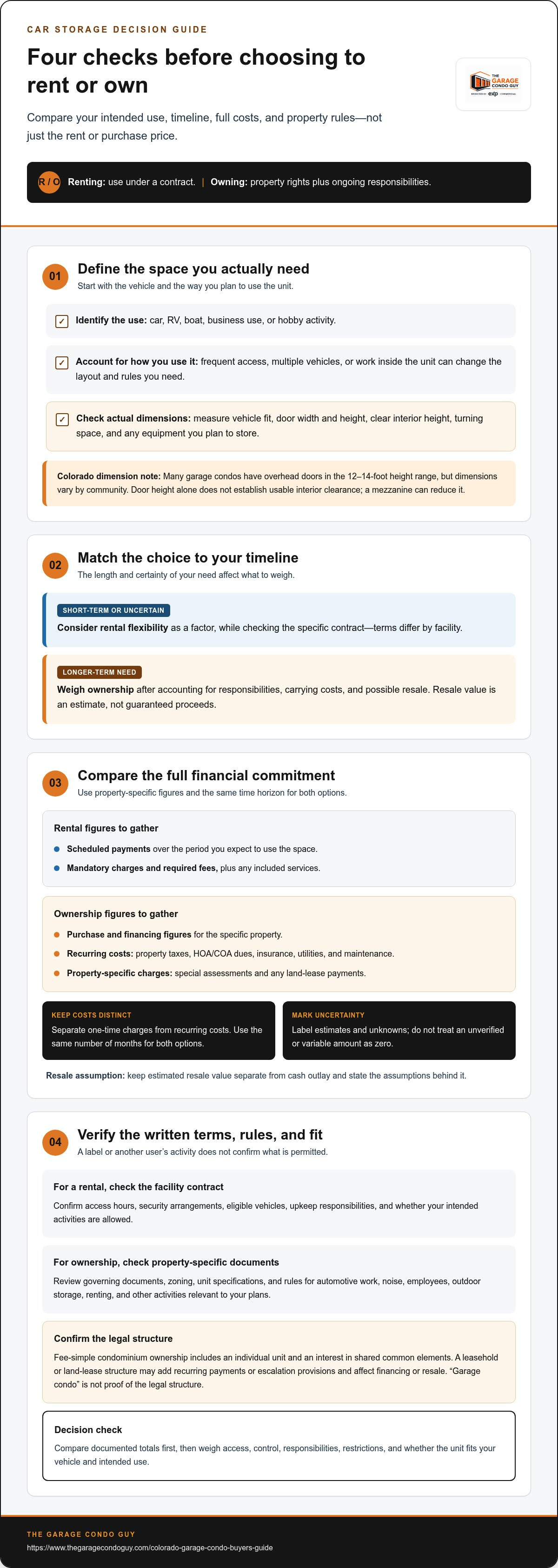
How to Decide Whether Renting or Owning Car Storage Fits Your Situation
Base the decision on your vehicle, intended use, and timeline. This four-step framework helps you compare practical fit before committing:
Define the use. Decide whether you need space for a car, RV, boat, business use, or hobby activity. Frequent access, multiple vehicles, or work inside the unit can change the layout and rules you need.
Assess your time horizon. If your need is short-term or uncertain, rental flexibility may be useful, but contract terms differ. For a longer-term need, weigh ownership after accounting for its responsibilities, carrying costs, and possible resale.
Compare written terms. Put rental terms beside property-specific ownership costs, financing terms, and obligations. Use actual figures for each option, not assumptions or general averages.
Verify restrictions and fit. Check applicable zoning and HOA/COA documents for your intended use. Confirm the unit’s dimensions, utilities, and condition against your requirements.
Match the storage choice to your vehicle and use
Measure the vehicle and consider door width, door height, clear interior height, turning space, and any equipment you plan to store. Many Colorado garage condos have overhead doors in the 12-14-foot height range, but dimensions vary by community. Door height alone does not establish usable clearance inside. A mezzanine can reduce clear height, so verify the actual space beneath it. Utilities also vary by community. Electrical service, water, plumbing, heating, air-conditioning, or other features may require HOA/COA approval, and you should verify permission before planning an addition.
Use a property-specific due-diligence checklist
For a purchase, review the declarations, covenants, bylaws, rules, budget, financial statements, meeting minutes, insurance, reserves, and any special assessments. Check use restrictions for business activity, customer traffic, employees, automotive work, noise, hazardous materials, outdoor storage, signage, renting, overnight stays, pets, mezzanines, lifts, plumbing, HVAC, and unit alterations. Inspect the roof and structure, concrete slab, overhead door and opener, electrical system, heating and air-conditioning, plumbing, fire sprinklers, drainage, windows and doors, and any mezzanine and stairs. Confirm that upgrades were approved and permitted. For a Denver-area search, compare the unit’s practical fit and community documents with your needs.
These checks make owning vs renting car storage a property-specific decision rather than a guess based on labels or appearances. Use the Colorado garage-condo buyer’s guide to prepare for ownership due diligence.
Colorado Car Storage: Practical Next Steps Before You Rent or Buy
Compare the written rental terms with the full financial and practical picture of a specific property. Possible funding routes for a purchase include commercial real-estate loans, local bank financing, credit-union financing, SBA financing for qualifying owner-occupied business uses, seller financing, or cash. Options and terms depend on the transaction. Lender approval may depend on the specific project, so pre-qualification can help you understand financing parameters before making an offer.
What should Colorado buyers verify before making an offer?
Confirm the ownership structure through the property documents. Verify zoning, permitted uses, utilities, clear height, carrying costs, financing terms, and required approvals. Assess the location against your routine: distance from home, gated entry, security cameras, amenities, highway access, and peak-hour drive time can affect how useful the space is. For local searches across the Denver Front Range, Boulder, Longmont, Lakewood, Superior, Dacono, Golden, Centennial, Aurora, Castle Rock, Broomfield, Englewood, Highlands Ranch, Littleton, and Commerce City, compare each property’s documents, access, and location rather than assuming communities have the same features.
When does specialist buyer guidance help?
The Garage Condo Guy provides buyer representation for garage condos and car condos in Colorado. Buyer guidance can bring the governing documents, inspection findings, financing, carrying costs, and resale considerations into one property-specific review. This is useful when a unit’s layout or community rules could affect how you store a vehicle or use the space. Review unresolved questions before proceeding, particularly those involving permitted uses, utilities, clearances, or ownership structure.
Use the Colorado garage condo buyer’s guide to organize your purchase review.
General educational information only. Verify property-specific zoning, HOA/COA documents, taxes, financing and legal requirements before purchase.
Make Your Next Car Storage Decision With Clarity
Before committing, define what a suitable storage arrangement needs to provide. List your non-negotiables, the compromises you can accept, and the conditions that would make you reconsider. For example, note the vehicle’s measurements, the access you need, the activities you plan to do in the space, and the costs you can document. That gives you a practical way to compare options instead of relying on a label or a single appealing feature.
The owning vs renting car storage choice should rest on evidence. Compare the actual space and written terms with how you expect to use it. If ownership is on the table, use a structured review before moving forward. The Colorado garage condo buyer’s guide can help you prepare to evaluate a potential purchase.
A clear decision means choosing an arrangement that fits your priorities and recognizing its commitments. To discuss garage condo buyer representation in Colorado, contact The Garage Condo Guy by phone or email.
Frequently Asked Questions
Is renting car storage better for seasonal vehicle storage?
It can be a practical fit if you need space only during part of the year and the rental terms suit that schedule. Before storing a classic car for winter, check the minimum rental period, notice required to end the agreement, and move-in or move-out conditions. Seasonal demand and availability can vary, so don’t assume a space will be available when you need it.
Can I access a rented car storage space at any time?
Not necessarily. Access depends on the facility’s contract and operating policies. A space might be available only during stated hours, or access outside those hours might require prior approval. Before signing, check how entry works on weekends and holidays, whether there are vehicle-access limits, and what happens if you need to retrieve the car outside normal hours. Don’t treat advertised security as proof of unrestricted access.
Can I rent out a garage condo that I own?
Ownership alone does not establish a right to rent the unit. Review the condominium declaration, bylaws, rules, and any lease-related provisions, then verify applicable zoning and other requirements. Check whether restrictions address tenant eligibility, lease duration, business use, or vehicle storage. In Denver and across the Front Range, confirm the rules for the specific community rather than relying on another owner’s rental arrangement.
What happens if a garage condo has a land lease?
A land lease means the unit may be subject to separate lease terms for the land, potentially including recurring payments or escalation provisions. Those obligations can affect total carrying costs, financing options, and resale. Read the lease for its term, payment schedule, renewal conditions, and transfer requirements, then include those terms in your ownership comparison. Don’t assume the unit’s marketing name tells you whether the land is owned.
How do I compare rental and ownership costs without a reliable estimate?
Build a side-by-side worksheet using written figures for the specific options, and mark unknowns instead of filling them with averages. For a rental, use the contract’s payment schedule and terms. For ownership, gather figures from property documents, tax information, insurance quotes, and financing proposals. Apply the same planned time horizon to both. For comparisons around Denver, Boulder, Longmont, Lakewood, Superior, Dacono, Golden, Centennial, Aurora, Castle Rock, Broomfield, Englewood, Highlands Ranch, Littleton, and Commerce City, keep each property’s records separate.


Comments